
Table of Contents
Summary
A GST rejection in Bangalore rarely means the end of your registration plan. It usually means one link in your paperwork broke, such as a name that differs from PAN, an address proof that does not match, or a notice that nobody answered in time. This guide maps every rejection ground to the stage where it hits, shows what officers cannot ask for, and tells you whether to reply, reapply or appeal. Read it once before you file, and keep it open if a notice has already reached you.
Key takeaways
- Know your stage first. Rejected, pending for clarification, no ARN and cancelled are four different situations, and each one has its own fix.
- Most grounds are correctable. Name mismatches, weak scans and unclear addresses are process defects, not permanent bans.
- The clock is short. You get 7 working days to reply to a REG-03 notice in REG-04, and the officer can reject once that window closes. The officer may reject within 7 working days after the reply time expires.
- Rule 9A can speed things up. Low risk applicants can receive electronic approval within 3 working days. Flagged cases take longer, and physical verification can stretch the process to 30 days.
- Karnataka adds a biometric step. If your email asks you to visit a GST Suvidha Kendra, book the slot inside the permitted period, or your ARN will not appear.
- Your address proof is a chain. Owner, ownership document, agreement or consent, your name and your application address must all match. Rebuild the chain before you refile.
- Officers have limits. CBIC Instruction No. 03/2025-GST bars presumptive queries and unlisted document demands. Extra documents need approval from a Deputy or Assistant Commissioner. Use this politely in your reply.
- Reapplying is simple. A fresh application gets a new ARN, with no fee and no mandatory waiting period. Fix the defect first, because the same defect invites the same result.
- Appeals have a deadline. Section 107 gives you three months from communication of the order, plus one more month if you show sufficient cause.
- No one can guarantee approval. The officer and the risk engine decide, so treat any guaranteed approval promise with care.
Introduction
You filled the form. You uploaded your papers. Then the portal shows REG-05, or a query notice lands in your inbox, and your plans stop right there.
Take a breath. Most GST rejections in Bangalore come from a small gap that you can fix: a name that differs by one letter, an address proof that does not match, or a notice nobody answered in time. This guide shows you every rejection ground, the stage where it hits, and how to fix it. It also shows what officers are not allowed to ask for, so you can reply to a query with confidence.
Quick answer: why do GST applications get rejected in Bangalore?
A GST application gets rejected when the officer finds a problem your reply does not solve, or when you miss the reply window. The common triggers are a PAN and Aadhaar name mismatch, address proof that does not match or does not prove your place of business, a failed Aadhaar or biometric step, a REG-03 notice left unanswered for 7 working days, and a failed physical verification.
Most of these are correctable. Reply to the notice in REG-04 on time. If the order has already come in REG-05, file a fresh REG-01 after fixing the defect, or appeal under Section 107 within three months.
What a GST rejection really means
A rejection means the proper officer refused your registration and recorded the reasons in Form GST REG-05. The officer can reject only after a REG-03 notice, and only if you gave no reply or a reply that did not satisfy them. The officer must record reasons in writing and communicate the rejection in REG-05 within 7 working days of your reply.
Many people mix up the statuses on the portal. Here is how to read each one.
- Rejected: Your REG-05 order is out. Find it under Track Application Status and View Notices and Orders. That ARN is closed for good, and reapplying creates a new one.
- Pending for clarification: You received a REG-03 query notice. People often call it a show cause notice, but it is a request for clarification. You still have time to reply in REG-04.
- No ARN generated: Your application never completed. In Karnataka, the ARN is generated only after the biometric authentication and document verification are finished. If you saved a draft, look under My Saved Applications, where it appears with your TRN.
- Cancelled or suspended: This happens after registration, not before. It follows a different remedy called revocation under Section 30, so do not treat it like a rejection.
How GST registration processing works in 2026
Knowing the clock helps you spot who is late, you or the department.
- You file Form GST REG-01. In Karnataka, you either complete Aadhaar OTP authentication or book a biometric slot at a GST Suvidha Kendra.
- The portal’s risk engine scores your application. Since 1 November 2025, Rule 9A lets the system approve low risk applications electronically within 3 working days. Rule 14A, brought in through Notification No. 18/2025 Central Tax under the CGST (Fourth Amendment) Rules, 2025, adds an optional simplified route for suppliers whose monthly output tax on B2B supplies stays within ₹2.5 lakh. Aadhaar authentication is needed for both.
- If the system does not flag you as risky and your file is complete, the officer should approve within 7 working days.
- If you are flagged as risky, or you skip Aadhaar authentication, the officer carries out physical verification, and registration follows within 30 days. The officer must upload the REG-30 report at least 5 days before that deadline.
- If something is missing, the officer sends REG-03 within 7 working days (30 days for risky cases).
- You reply in REG-04 within 7 working days of receiving the notice.
- If you send no reply, the officer may reject within 7 working days after your time runs out.
Count working days, not calendar days, and write the notice date on your calendar the moment it arrives. That is your date fenced reply window.
One more point. On paper, Rule 9(5) allows deemed approval when an officer does not act. But CBIC has told its officers to make sure no application is approved on a deemed basis for want of timely action. Do not plan around silence.
The Bangalore factor: what is different in Karnataka
Karnataka is one of the first states where biometric checks became part of registration. GSTN rolled out biometric based Aadhaar authentication in Bihar, Delhi, Karnataka and Punjab from 6 September 2024. After you submit REG-01, you receive an email that either carries an OTP link or asks you to book a slot at a GST Suvidha Kendra for biometric authentication and document verification. Other states, including Maharashtra, run their own Suvidha Kendra arrangements, and the rollout has widened over time, so check the GSTN advisory for your state if you file outside Karnataka.
Bangalore paperwork also has its own flavour:
- The BESCOM electricity bill is the most common ownership or possession proof.
- Property tax receipts and khata records carry the owner’s name, and Bangalore records are moving to eKhata, with the Greater Bengaluru Authority now sitting alongside BBMP. Always use the latest record in the owner’s name.
- Many addresses in HSR Layout, Koramangala, Indiranagar, Whitefield, Electronic City and MG Road sit inside multi tenant buildings. A building name, floor and unit number that vary across documents will draw a query quickly. One field visit rejection involved two firms sharing an address without clear demarcation, which looked like a shell company risk.
Every GST rejection ground, explained

We grouped the grounds by the stage where they hit you. For each one, you get what goes wrong and how to fix it.
Before the ARN
1. Aadhaar authentication failed or the biometric slot was missed
The OTP goes to the mobile number linked to Aadhaar. If that number is old, or the name or date of birth differs from the application, authentication fails. Applicants who fail to authenticate Aadhaar, or choose not to, go through physical verification of the premises. Under Rule 8(4A), the biometric route replaces the OTP route, and the intimation email tells you how long you have to book a slot.
Fix it: update the mobile number with UIDAI first, then reapply. If you got the biometric email, book a slot inside the permitted period, and carry your appointment confirmation email, your original Aadhaar and the originals of every document you uploaded. The verification covers every person listed in your REG-01. So partners and directors may need to attend too.
2. PAN and Aadhaar name mismatch
Some guides call this the most common cause, and even a missing middle name or a spelling variation can flag the application. The fix is to write your name exactly as per PAN and Aadhaar. If the two documents disagree, correct the source document first, because a portal workaround only delays the next query.
At the REG-03 stage
3. Address proof rejected or mismatched
This is the ground that triggers the most notices. The officer can send a REG-03 when the address does not match the uploaded document, when the document does not look like valid proof, or when the address is incomplete or vague. Think of your address proof as a chain, and rebuild the address proof chain link by link: owner, ownership document, agreement or consent, your name, application address. Each link must carry the same address text.
What the chain needs in each situation:
- Owned premises: Any one ownership document is enough, such as a property tax receipt, municipal khata copy, electricity bill or water bill.
- Rented premises: A valid rent or lease agreement plus one ownership document of the lessor. If the agreement is unregistered, add the lessor’s ID. If it is registered, no lessor ID should be sought. If the electricity or water connection is in your name as tenant, that bill plus the agreement works.
- Spouse or relative owns it: A consent letter on plain paper, the consenter’s ID proof, and one ownership document of the consenter.
- Shared premises: An agreement with an ownership document, or a consent letter with the consenter’s ID and ownership proof if no agreement exists.
- No rent agreement at all: An affidavit on non judicial stamp paper, signed before a First Class Judicial Magistrate, Executive Magistrate or Notary Public, plus an electricity bill in your name.
In Bangalore, many commercial spaces run on leave and licence or sub licence arrangements. These usually play the same role as a rent agreement in the chain, but make sure the document names the owner, the exact premises and your business, and attach the owner’s ownership proof with it.
4. Virtual office and coworking addresses
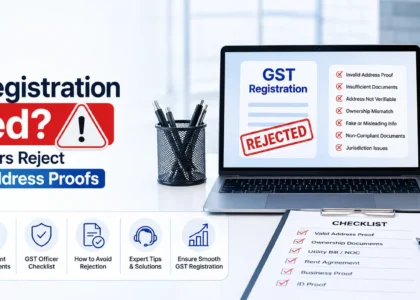
Do virtual offices get GST registration rejected? Not because they are virtual. They get rejected when the paperwork or the place is weak. A provider with no real, inspectable location means a verification visit finds only a mailing address. That is a weakly documented virtual office, and it fails at the physical verification stage.
To stay safe, pick a provider with a staffed, working space. Keep the agreement in your business name, the owner’s ownership proof for the space, any NOC the provider issues, and signage photographs ready for the officer. The CBIC instruction does not use the words virtual office. It covers shared and consent premises, which is how these addresses are judged. For the document level detail, read our guide on 7 Reasons Officers Reject Virtual Office Address Proofs.
5. Vague business description, HSN and SAC
A vague business description is not one of the listed REG-03 grounds, but officers still raise it when your nature of business reads like a guess. Describe what you actually do, who you sell to and where, for example trading of goods to businesses, or a service supplied to B2B clients. Pick the right HSN or SAC code, and keep the description consistent with your output tax plans, whether you trade, provide services, or run as an ecommerce seller. Officers should not raise presumptive queries, such as claiming your HSN code is banned in the state or that the activity cannot run from those premises.
6. Constitution, authorisation, bank and DSC problems
Your proof of constitution depends on your business type:
- Partnership firms upload the partnership deed. Societies, trusts, clubs and similar bodies upload their registration certificate.
- Private limited companies and LLPs upload the incorporation certificate, and a board resolution or authorisation letter that names the authorised signatory. Proprietorships need none of this, only the proprietor’s own documents.
- Companies and LLPs also need a valid DSC for signing.
- For bank proof, upload a cancelled cheque or a bank statement page that clearly shows the account holder name, account number, IFSC and branch, in the business name.
7. Poor scans and validation errors
Officers must check that your documents are legible, complete and relevant. Blurry photos, cut corners and files that breach the portal’s size and format limits cause avoidable notices. Scan each document flat, in good light, as a clear PDF or image with all four corners showing. If you hit a validation error on the portal, fix the file before you submit, not after.
8. Cancelled or suspended GSTIN on the same PAN
The officer can ask for clarification when any GSTIN linked to your PAN is cancelled or suspended. The officer sees every registration on your PAN, so explain the history openly in REG-04 and attach proof of any closure.
At the decision stage
9. The REG-03 notice sat unanswered
An unanswered clarification notice is the easiest rejection to avoid. If you do not reply within 7 working days, the officer may reject. Check both your email and View Notices and Orders, because the notice sits on the portal even if the email lands in spam.
10. Physical verification did not go well
Is physical verification bad for GST registration? No. It is a normal route for flagged applications, and it is not a rejection. The officer must report whether your place of business exists, record the efforts made to find it if it does not, and upload GPS enabled photographs. That is why premises verification readiness matters.
Before the visit, check these points:
- A board or signage with your business name
- An owner or staff member present to meet the officer
- Originals of every document you uploaded
- The unit number and floor visible and matching your application
11. Fake or tampered documents
Officers may cross check your address proof against public sources such as land registry, electricity distribution company and municipality websites. The portal’s risk assessment engine also flags unusual patterns. Never edit a bill, reuse someone else’s agreement, or change a date. That draws closer officer scrutiny and can lead to serious consequences far beyond a rejection.
12. Non resident directors and foreign owned companies
A foreign owned company or a company with a non resident director can still register. A foreign national has no Aadhaar, so the portal asks for passport details and a foreign address instead. Write every name exactly as on the passport and keep it aligned with the incorporation records. If you can, appoint an India resident signatory so Aadhaar authentication runs smoothly. FEMA rules for a foreign subsidiary are a separate matter from GST registration, but your director and shareholder details must still match your company records. This is also different from non resident taxable person registration, which is a separate category. Because this area has special cases, speak to a CA before you file.
What officers cannot ask for: your biggest loophole
This is the part most guides skip. The CBIC Instruction No. 03/2025-GST of 17 April 2025 limits what a registration officer may ask. Here is what that means in practice, so you can spot overreach in a REG-03 notice.
- If the officer asks for the lessor’s Aadhaar, PAN or photograph: One ownership document of the lessor should be enough, and a registered agreement needs no lessor ID at all.
- If the officer demands original physical copies of ownership proof: The instruction says the query should not seek them.
- If a partnership firm is asked for Udyam, MSME, shop establishment or trade licence papers: The partnership deed is the proof of constitution, and no additional document should be sought.
- If the officer questions why the signatory lives in another city or state: The instruction names this as a presumptive query that officers should not raise.
- If the officer asks for papers beyond the listed documents: That needs prior approval from the concerned Deputy or Assistant Commissioner.
- If the notice raises minor issues that do not affect proof of place of business or constitution: Officers are told not to raise queries for such small deficiencies.
You do not need to argue or sound angry. In your REG-04, politely name the instruction and its date, answer the query anyway where it is easy, and note that the extra request goes beyond the prescribed document list. That tone works better and keeps your record clean.
What if the rejection came without any notice? Check View Notices and Orders first, because REG-03 might be sitting there. If REG-05 truly arrived with no notice, or without clear reasons, that is a strong ground for an appeal. Karnataka High Court has set aside GST orders where taxpayers got no real hearing or never received notices, but those cases concerned cancellation and assessment, not fresh registration. So treat them as context, not a promise.
Myths that waste your time

- “The utility bill must be under two months old.” Different websites quote two months, 60 days or three months. The CBIC instruction itself refers to the latest bill. Use the newest bill you have, but do not panic over a number nobody can point to in the rules.
- “An unregistered rent agreement is useless.” It works when you attach one ownership document and the lessor’s ID.
- “Coworking always needs an affidavit.” The affidavit route is for situations where no rent or lease agreement exists.
- “Silence means approval.” See the deemed approval note above.
- “A fixed number of GSTINs at one address triggers a visit.” The CBIC instruction sets no such number. The risk parameters themselves are not public.
- “File APL-01 to reapply.” APL-01 is the appeal form. Reapplying means a fresh REG-01.
- “You have 30 days to appeal.” Section 107 gives three months from the date the order is communicated, with one more month if you show sufficient cause.
How to reply to a REG-03 notice in REG-04
- Read the full notice and note the date. Count 7 working days from receipt and set a reminder two days before.
- List every query and match each to one document. If the officer raised three points, your reply needs three clear answers.
- Fix the source problem. Get a sharper scan, a fresh NOC or a corrected agreement. Do not upload the same weak file again.
- Write a point wise reply with named documents. Say exactly which uploaded document answers which query.
- Upload before the deadline and track your ARN every day under Track Application Status.
Here is a sample reply you can adapt:
Subject: Reply to notice in Form GST REG-03 for ARN [your ARN]
Respected Sir or Madam,
This is our reply in Form GST REG-04 to your notice dated [date].
Query 1: The address on the electricity bill does not match the application.
Reply: The complete address is [full address with floor and unit]. The BESCOM bill uploaded as Document 2 shows this address, and the account sits in the owner’s name, [owner name]. The rent agreement in Document 1 names the same premises. We have also uploaded the property tax receipt as Document 3 to confirm ownership.
Query 2: The authorisation for the signatory is not clear.
Reply: The board resolution uploaded as Document 4 names [signatory name] as authorised signatory.
We request you to approve the application. We will share any further document you need.
Thank you,
[Name], Authorised Signatory
Reply, reapply or appeal: which one should you pick?
- You are still inside the REG-03 window: Reply in REG-04. This is the cheapest and fastest exit.
- REG-05 is out and the problem was real: Fix the defect and refile. Reapplying creates a fresh application with a new ARN, and there is no reapplication fee and no mandatory waiting period. This route is usually quicker than an appeal.
- REG-05 is out and the reasons are wrong, missing or unreasoned: Appeal. You file Form GST APL-01 on the portal to the Appellate Authority. The appeal covers decisions on registration and must reach the authority within three months of the order’s communication. The authority can allow one more month for sufficient cause, and after that it generally cannot take the appeal. Pre deposit rules under Section 107(6) are built around disputed tax amounts, and a rejected registration has no tax demand attached, so confirm the current position on the portal or with your CA before you file.
Will a rejection affect your future applications? A rejection is not a penalty. But if you file the same defective application again, the officer has no reason to believe the new one differs. Repeated defective attempts on the same PAN, with the same defect, invite repeat rejection. So fix the cause first, and then cure and refile.
Your pre filing checklist to avoid GST rejection
Use this GST registration documents checklist to build a defect free application.
The name and address chain
- One legal name, written exactly as on PAN, matching Aadhaar
- The same building name, floor, unit and pin code in REG-01, the agreement and the bill
- The owner’s name matches across the ownership document and the agreement
- The Aadhaar mobile number is active, and you can receive the OTP
By situation
- Owned: One ownership document in your name.
- Rented: Agreement, one lessor ownership document, plus lessor ID if the agreement is unregistered.
- Shared or family owned: Consent letter, consenter’s ID, and the consenter’s ownership proof.
- Virtual office: Agreement in your business name, ownership proof of the space, provider NOC, signage photographs and a staffed location.
Final readiness checks
- Biometric slot booked, if the email asked for it
- Authorised signatory named, with the authorisation letter or board resolution ready
- HSN or SAC code confirmed and the business description specific
- Every scan legible and passport size photographs clear
- DSC ready, for companies and LLPs
“Guaranteed GST approval”: legit or not?
No honest provider can guarantee approval. The officer and the risk engine decide, not the consultant. A credible promise sounds different: they check your documents carefully, they use a real and inspectable address, and they put in writing that they will fix or refund errors caused on their side. Be careful with anyone who promises a GSTIN by a fixed date no matter what.
FAQs
Why was my GST registration rejected?
The usual reasons are a name mismatch, address proof that does not match, a failed Aadhaar or biometric step, an unanswered REG-03, or a failed verification. Open your REG-05 to see the exact reasons the officer recorded.
Can I apply again if my GST registration is rejected?
Yes. File a fresh REG-01 after fixing the defect. There is no reapplication fee and no mandatory waiting period.
Can GST registration be rejected twice?
Yes, if the same defect remains. Fix the cause before refiling, since the officer can see your earlier attempts on the same PAN.
Will a rejected application affect my PAN?
No. Your PAN stays valid. The new application simply links to it.
Can the same ARN be reopened?
No. A rejected ARN stays closed, and you start again with a new one.
How long do I have to appeal a GST registration rejection?
You have three months from the date the order is communicated, plus one more month if the Appellate Authority accepts your sufficient cause.
Is physical verification bad for GST registration?
No. It is a standard step for flagged applications and for applicants who skip Aadhaar authentication. It does not mean rejection.
Can I use my home address for GST registration?
Yes, if you can prove it. Use an ownership document if you own it, an agreement if you rent, or a consent letter if a spouse or relative owns it.
What if I have no rent agreement?
Use an affidavit on non judicial stamp paper, signed before a Magistrate or Notary Public, plus an electricity bill in your name.
Is an unregistered rent agreement valid for GST?
Yes, when you add one ownership document of the lessor and the lessor’s ID.
How long does GST approval take in Bangalore?
It can take 3 working days for a low risk application under Rule 9A, around 7 working days for a clean application, and up to 30 days when physical verification applies. A biometric appointment adds time before the ARN appears.
About the founder
Shivani, Founder of MyCoreOffice
Shivani started MyCoreOffice after more than a decade of working inside coworking spaces, virtual offices, ecommerce and real estate. That mix taught her something most compliance guides miss: GST officers do not judge paperwork alone, they judge whether an address looks and works like a real place of business.
She built MyCoreOffice around that idea. Today the company helps startups, freelancers and growing businesses get a GST compliant address, along with support for GST registration, company registration, coworking and office space.
Shivani cares about plain answers. She believes a founder should never have to guess why an application failed, which is why she backed this guide on every rejection ground, from REG-03 queries to REG-05 orders, and the exact way to fix each one.
About the author
The MyCoreOffice Team
This guide comes from the MyCoreOffice team, a group that works with GST registration support, virtual office addresses and company registration for founders across more than 50 cities in India. We see the same problem again and again. A good business loses weeks because one document does not match, or one REG-03 notice sits unanswered.
So we wrote this guide the way we would explain it to a client. We keep an eye on CBIC Instruction No. 03/2025-GST and the GSTN advisories, and we focus on the things you can control: a clean address proof chain, a name written exactly as per PAN and Aadhaar, an agreement and NOC that tell the same story, and a place of business that is ready for physical verification.
If your GST registration was rejected in Bangalore, or you want a defect free application before you file, the MyCoreOffice team is happy to look at your documents with you.
Conclusion
A GST registration rejected in Bangalore feels personal, but it is almost always a paperwork problem that you can solve. Open your REG-05 or REG-03 and read the exact reasons the officer recorded. Match every query to one document, and write a point wise reply with named documents. If you are still inside the notice window, reply in REG-04 and stop there.
If the rejection has already arrived, you have two clean exits. Fix the defect and file a fresh REG-01, or appeal under Section 107 through Form GST APL-01 when the reasons look wrong, missing or unreasoned. Either way, rebuild the address proof chain, get your physical verification readiness in order, and run the pre filing checklist before you click submit. A defect free application is your best protection against a second rejection.
Remember what the law gives you, too. The CBIC instruction tells officers to stay inside the prescribed document list, to record reasons in writing, and to avoid presumptive queries. Knowing that helps you answer calmly instead of panicking.
If you want a second pair of eyes before you file, or after a notice lands, the MyCoreOffice team can go through your documents with you.
This guide shares general information and does not replace legal or tax advice. For complex cases, such as non resident directors or foreign owned companies, speak to a CA before you file.