
Table of Contents
Summary
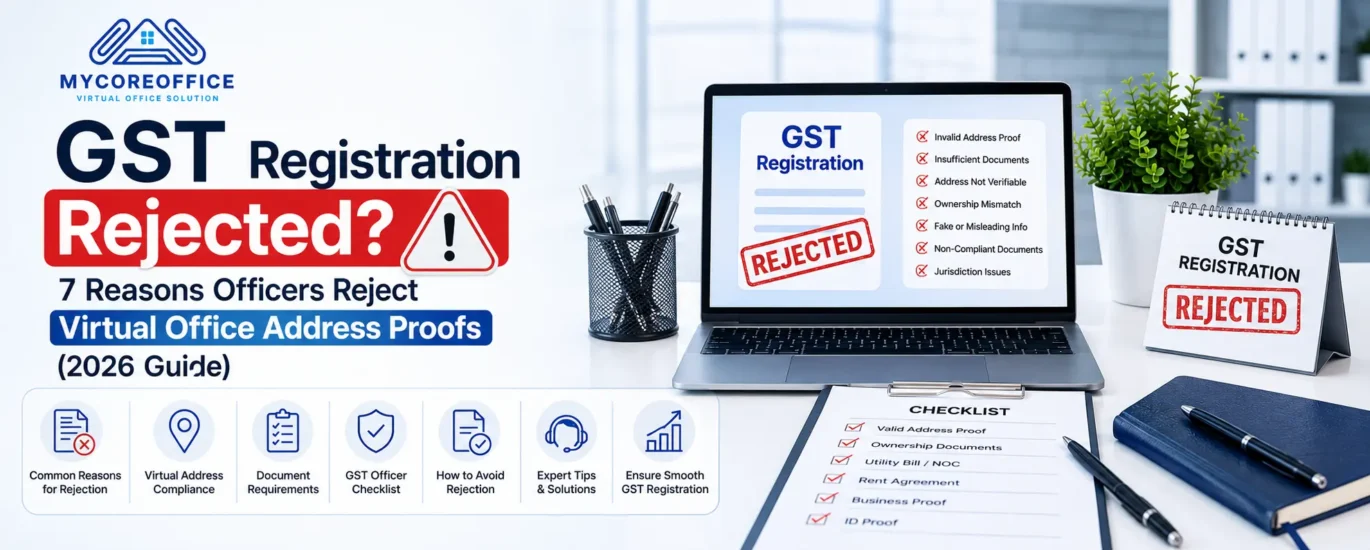
Getting your GST registration rejected because of a virtual office address is more common than most people realize, and honestly, it rarely has anything to do with the virtual office itself being invalid. In almost every case we have seen, the real issue comes down to something fixable, an NOC that was not formatted correctly, a utility bill that had gone slightly stale, or a site verification visit that did not find any visible sign of business activity at the address. The good news is that once you know exactly what GST officers are checking for, these rejections become genuinely avoidable.
This guide walks you through the seven real reasons applications get rejected, backed by the actual GST rules behind each one, along with what changed under the 2025 CBIC reforms, how different states tend to handle verification differently, and exactly what to do if you have already received a rejection notice. Whether you are applying for the first time or trying to figure out what went wrong the last time, everything here is written to actually solve the problem, not just explain it.
Key Takeaways
- A virtual office is completely valid for GST registration under CGST Act sections 22 to 25. The law does not reject the concept, officers reject bad documentation attached to it.
- Your NOC or consent letter is the single most important document in the entire application. Get it properly signed and notarized, not just a generic template copy.
- Utility bills need to be recent, ideally within the last two months, and the name on the bill has to match the property owner named in your NOC. This one detail causes more rejections than almost anything else.
- Physical site verification is where most virtual office applications actually fail, even when the paperwork looks perfect. Visible signage and a staff member present during the visit window make a real difference.
- Skipping or failing Aadhaar biometric authentication almost guarantees a physical site visit, so it is worth preparing your premises in advance rather than being caught off guard.
- The April 2025 CBIC reform actually works in your favor. Officers are now restrained from demanding documents beyond what the rules specify, so you have grounds to push back if asked for anything extra.
- GST officers do not apply the same level of scrutiny everywhere. Delhi, Mumbai, Bangalore, Gurgaon, and Noida each have slightly different tendencies worth knowing before you apply.
- A rejection is not the end of the road. You can respond through Form GST REG-04 or simply reapply under Rule 9 once the flagged issue is corrected.
- Multiple businesses registered at the same virtual address is not illegal on its own, but each registration needs its own clean, individual documentation to avoid getting flagged during fraud checks.
- Choosing the right virtual office provider matters more than people think. A provider that understands GST compliance, prepares your NOC correctly, and knows how to handle a site visit will save you from most of these problems before they ever happen.
Introduction
If your GST registration application got rejected and you were using a virtual office address, you are probably staring at a rejection remark that makes very little sense, wondering whether virtual offices are even allowed under GST law in the first place. Here is the short answer. They are allowed. What gets rejected almost every single time is not the concept of a virtual office, it is the documentation attached to it. GST officers are not rejecting the idea of working out of a shared or virtual space. They are rejecting incomplete paperwork, mismatched details, and applications that fail physical verification. Once you understand exactly what officers are checking for, most of these rejections become completely avoidable.
This guide breaks down the real reasons applications get rejected, ties each one back to the actual GST rule behind it, and walks you through what to do if you have already been rejected once.
Is a Virtual Office Valid for GST Registration
Under the CGST Act 2017, specifically Sections 22 to 25, a business needs a principal place of business to register for GST. Nowhere does the law say this place has to be owned outright or has to be a traditional office. A virtual office can serve as your principal place of business or even as an additional place of business, as long as you can produce a valid agreement, a consent letter or NOC from the property owner, and a recent utility bill.
CGST Rules 8, 9, and 25 lay out exactly how this documentation and verification process is supposed to work. So when an application gets rejected, the issue is rarely the virtual office itself. It is almost always something in the paperwork trail that does not hold up to scrutiny.
What Documents Are Required Under Form GST REG-01
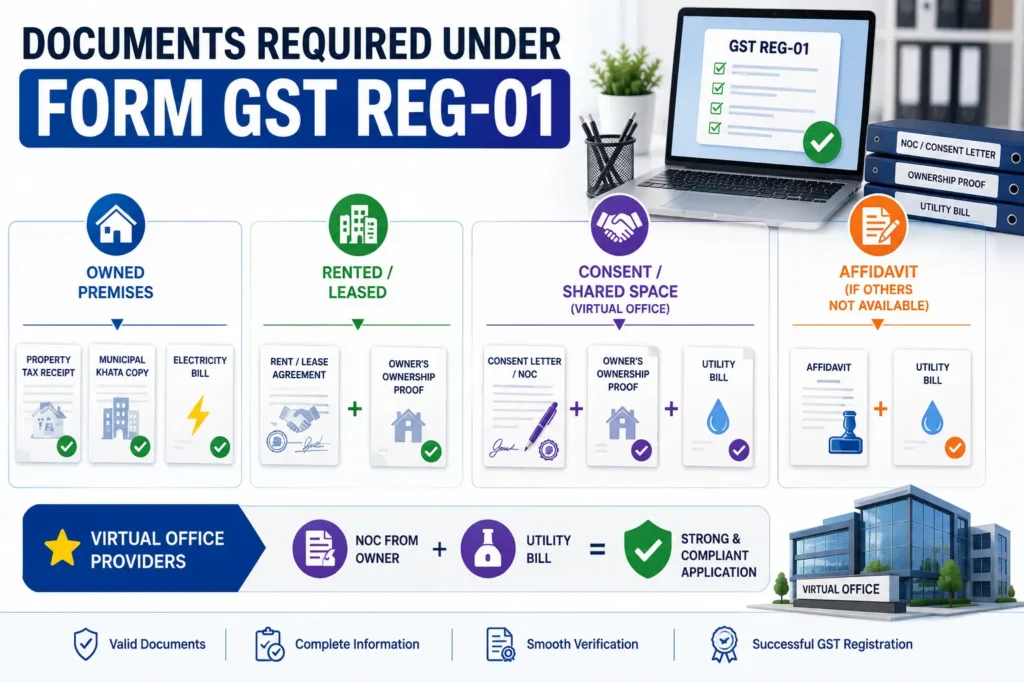
The address proof requirements change slightly depending on how you occupy the premises.
If you own the premises, you need a property tax receipt, a municipal khata copy, or an electricity bill in your name.
If you are renting or leasing, you need a valid rent or lease agreement along with the owner’s proof of ownership.
If you are using a consent arrangement or a shared space, which is exactly what a virtual office falls under, you need a consent letter or NOC from the property owner, the owner’s ownership proof, and a utility bill.
If none of these are available, an affidavit along with a utility bill in your name can work, though this route invites more scrutiny.
Virtual office providers almost always fall into the consent or shared premises category, which means the NOC and the utility bill become the two most important documents in your entire application.
The 7 Reasons Officers Reject Virtual Office Address Proofs
Defective or Missing NOC or Consent Letter
This is by far the most common reason applications get sent back. The NOC has to be properly formatted, signed by the actual property owner, and ideally notarized. Officers frequently reject applications where the NOC is unsigned, generic, or does not clearly state that the owner is permitting the applicant specifically to use the address for business registration.
Utility Bill Problems
A utility bill sounds simple until it becomes the reason your application gets stuck. Two issues come up again and again. The name on the bill does not match the property owner named in the NOC, or the bill is older than the window GST rules typically expect, which is usually within the last two months. An outdated or mismatched utility bill is one of the fastest ways to trigger a rejection.
Rent or Service Agreement Defects
If your virtual office arrangement includes a service or rent agreement, it needs to be complete, properly signed, and ideally carry the applicable stamp. Agreements missing the rent amount, missing signatures, or already expired are a common trigger for rejection notices.
Multiple GST Registrations at the Same Address
When dozens of businesses are registered at the same virtual address without clear individual documentation, it raises a red flag for officers who are actively watching for fraudulent registrations. This does not mean multiple registrations at one address are illegal. It means each one needs airtight, individual documentation to avoid getting caught in a broader crackdown.
Failed Physical or Site Verification
Under Rule 25, officers can conduct a physical verification of the premises, and the result gets recorded in Form GST REG-30 along with a photograph of the location. If the officer visits and finds no signage, no staff present, or a locked space with no sign that any business activity happens there, rejection is almost guaranteed. This is the single biggest reason virtual office based applications fail even when the paperwork looks perfect on paper.
Address Mismatch Across Documents
Your PAN, your Aadhaar, the agreement, and the application form all need to show the same address details. Even small inconsistencies, like a slightly different spelling of a locality name or a missing floor number, can be enough for an officer to flag the application.
Poor Quality or Wrong Document Uploads
This one sounds almost too simple to matter, but it happens constantly. Blurred scans, the wrong file uploaded entirely, or missing pages from a multi-page agreement lead to instant rejection notices that have nothing to do with whether your virtual office is legitimate.
Biometric Aadhaar Authentication and Its Role
GST registration now increasingly requires biometric based Aadhaar authentication, which has been rolled out state by state. If you fail this authentication step or choose to skip it, your application automatically gets routed toward mandatory physical verification at your jurisdictional GST office. This means virtual office applicants who skip or fail Aadhaar authentication should expect a site visit and should prepare their space accordingly.
The 2025 CBIC Reform: What Actually Changed
In April 2025, CBIC issued Instruction No. 03 of 2025-GST, which specifically restrained officers from demanding excessive or unnecessary documents beyond what is actually required under the rules. This came after Instruction No. 03 of 2023-GST, issued in June 2023, which had tightened registration scrutiny considerably to curb a wave of fake and fraudulent GST registrations.
What this means practically is that if an officer asks you for documents beyond the indicative list under REG-01, you now have grounds to push back and reference this instruction directly. A lot of older content on this topic was written before this reform and still assumes the stricter 2023 environment, which is one reason why virtual office applicants keep running into confusion about what is actually required today.
State Wise Rejection Patterns
GST officers do not apply the rules identically across every state, and the practical experience of applying with a virtual office address in Delhi looks different from applying in Bangalore or Pune.
In Delhi, officers tend to be strict about NOC notarization and often ask for the owner’s PAN card alongside the consent letter.
In Maharashtra, the commercial tax department frequently cross checks utility bill dates very closely and rejects bills older than the accepted window without exception.
In Karnataka, particularly Bangalore, physical site verification is applied more liberally, and officers commonly visit even when Aadhaar authentication succeeds.
In Telangana, verification tends to focus heavily on whether signage is visible at the premises during the visit.
In Haryana, especially in Gurgaon given the density of coworking and virtual office setups, officers are known to specifically check for multiple registrations at the same address and ask for additional justification.
In Noida and the broader Uttar Pradesh region, address mismatches between Aadhaar and the application are flagged more often than in other states, so double checking this before submission is worth the extra few minutes.
Site Verification Survival Checklist
Since failed site verification is one of the most common rejection triggers, here is what should be in place before an officer visits your virtual office address.
A visible nameboard or signage displaying your business name at the premises.
A staff member or receptionist available and briefed on your business during the likely visit window.
A physical copy of your registration documents kept on file at the location, ready to show if requested.
Proof that mail or courier addressed to your business is received and handled at that address.
Reputable virtual office providers should already have these in place as part of their service, but it is worth confirming directly rather than assuming.
What to Do After Rejection: Reapplication and Appeal Guide
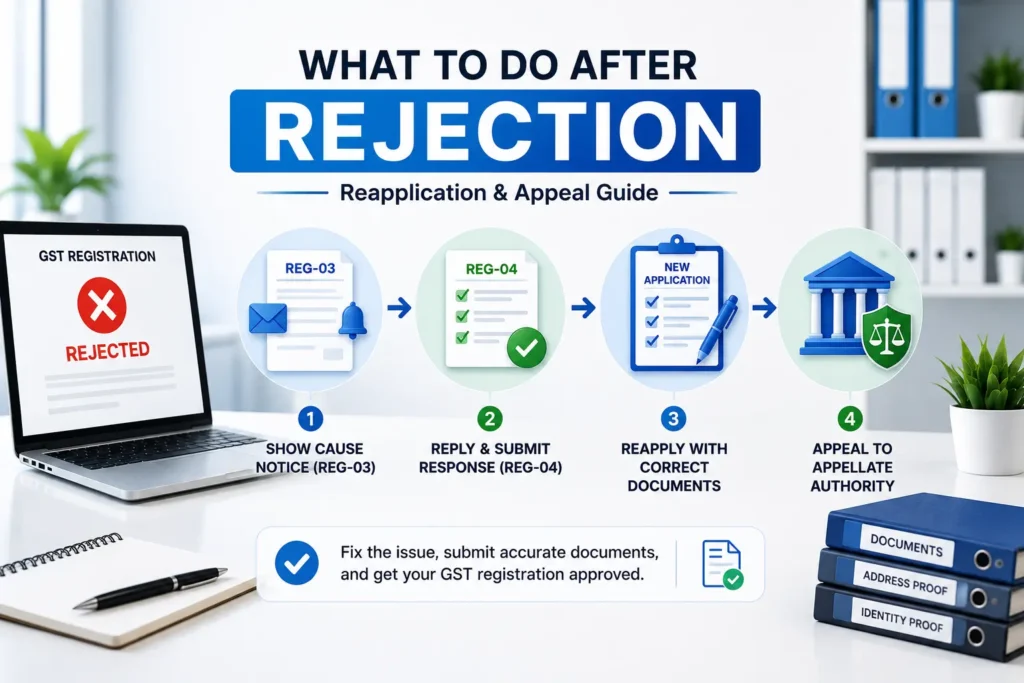
Getting a rejection is not the end of the process. Here is how to move forward.
If the officer issues a show cause notice through Form GST REG-03, you get an opportunity to respond. Your reply goes through Form GST REG-04, where you can address the specific concern raised and attach corrected or additional documents.
If your response does not resolve the issue or you missed the window to reply, you can submit a fresh application under Rule 9, this time making sure every document matches exactly and the site is prepared for verification.
If your application keeps getting rejected despite correcting the issues raised, you have the option to escalate through the appeal process, which involves approaching the jurisdictional appellate authority.
Most rejections at the virtual office stage are resolved simply by fixing the specific document flaw the officer pointed out and reapplying properly, without needing to go anywhere near a formal appeal.
Virtual Office vs Coworking Space vs Traditional Office for GST Purposes
All three can technically work for GST registration, but the documentation expectations shift slightly.
A traditional owned or rented office usually has the most straightforward paperwork since ownership or tenancy is already clearly established.
A coworking space functions similarly to a virtual office in that it typically requires a consent letter or service agreement along with a utility bill, and site verification checks for shared workspace usage evidence.
A virtual office requires the same consent based documentation but places more weight on whether the space can demonstrate genuine business activity during a site visit, since there is often no dedicated physical desk occupied daily.
How to Choose a GST Compliant Virtual Office Provider
Before booking a virtual office address for GST registration, it is worth checking a few things directly with the provider. Ask how many other businesses are currently registered at the same address and whether they maintain individual documentation for each. Ask whether they provide a properly notarized NOC format rather than a generic template. Ask what happens during a site verification visit and whether their staff are briefed to handle it. A provider that answers these questions clearly and has a track record of successful GST registrations across multiple cities is a far safer choice than one offering the lowest price with no clarity on compliance standards.
Downloadable Resources
To make this process easier, a ready to use NOC and consent letter template along with a full document checklist PDF are available for download, covering everything mentioned in this guide so you can verify your application before submission rather than after a rejection.
Frequently Asked Questions
Can I use a virtual office for GST registration?
Yes. A virtual office is a valid principal or additional place of business under GST law, provided the consent letter, ownership proof, and utility bill are in order.
What documents are needed for virtual office GST registration?
A notarized NOC or consent letter from the property owner, the owner’s proof of ownership, and a recent utility bill, typically within the last two months.
Why do GST officers reject virtual office addresses?
Rejections almost always come from documentation issues such as an improperly formatted NOC, an outdated or mismatched utility bill, or a failed physical site verification, rather than the virtual office concept itself.
Can I reapply after GST registration rejection?
Yes. You can respond to a show cause notice through Form GST REG-04, or submit a fresh application under Rule 9 after correcting the flagged issues.
Is site verification mandatory for virtual office GST registration?
Not always, but it becomes mandatory if Aadhaar authentication fails or is skipped, and officers can also choose to conduct it at their discretion under Rule 25.
How long does GST registration take with a virtual office address?
Processing time is generally similar to any other address type, typically within seven working days if Aadhaar authentication succeeds, though it can extend if physical verification is required.
About the Founder
MyCoreOffice was founded by Shivani, who brings 11 years of experience across coworking spaces, virtual offices, e-commerce, and real estate. That mix is exactly what shapes how the company operates day to day, documentation that is actually built to pass GST and MCA scrutiny, spaces backed by genuine real estate know-how, and a clear understanding of what e-commerce sellers need when they are expanding operations across different states.
Under her leadership, MyCoreOffice has grown into a presence across more than fifty cities in India, all built around one simple idea, give businesses an address that actually holds up when it gets tested, not just one that looks good on a website. It is that kind of grounded, experience-led thinking that makes MyCoreOffice a name businesses can genuinely rely on when it matters most.
About the Author
This article is written and maintained by the MyCoreOffice content team, the same people who work closely with our documentation, compliance, and virtual office operations across all fifty plus cities we serve. We are not writing this from a distance based on generic research alone. Every reason for rejection, every document requirement, and every state specific pattern mentioned here comes from what we actually see day to day while helping businesses get their GST registrations approved with a virtual office address.
Our goal with everything we publish is simple, give you information you can actually act on, not just content that sounds correct. If something changes in GST rules or CBIC instructions, we come back and update these guides rather than letting them sit outdated, because we would rather you trust what you read here than just scroll past another generic article.
Conclusion
At the end of the day, a rejected GST application because of a virtual office address is almost never about the virtual office being wrong for your business. It usually comes down to one small thing that slipped through, a document that was not quite formatted right, a bill that had gone slightly out of date, or a site visit that did not find what the officer was looking for. None of that means you made a bad decision choosing a virtual office. It just means something in the process needs to be tightened up, and now you know exactly what that is.
If you go back through your application with the seven reasons covered in this guide, chances are you will spot exactly where things went wrong, and fixing it is usually far simpler than people expect. And if you are just getting started and want to avoid all of this from day one, working with a provider that actually understands how GST officers verify these addresses makes a real difference. That is the entire reason MyCoreOffice builds its virtual office documentation the way it does, because getting your registration approved the first time should not feel like a gamble. We have helped businesses across more than fifty cities in India get this right, and we would rather you never have to read a rejection notice in the first place.
For More Info Contact Us