

Table of Contents
Summary
If you’re a founder, freelancer, consultant, or e-commerce seller trying to figure out how to get a legitimate business address without signing a five-figure office lease, this guide walks you through exactly what a MyCoreOffice workspace is, how it works, what documents you’ll need, and why it’s become a practical choice for businesses across India. We’ll cover the different plans, the registration process from start to finish, what to expect for GST and company registration, and how sellers on Amazon and Flipkart can use it for APOB compliance. By the end, you’ll know exactly what you’re signing up for and whether it fits your business.
Key Takeaways
- A MyCoreOffice workspace gives you a real, usable business address for GST and company registration – without renting or maintaining a physical office.
- Plans start at ₹999/month for a virtual office valid for GST, MCA, and banking purposes.
- GST registration through MyCoreOffice can be approved the same day, with no inspector visit required.
- Every plan comes with proper documentation – NOC, rent agreement, utility bill, and signage proof – the exact paperwork a GST officer, bank, or CA will ask for.
- MyCoreOffice operates in 50+ cities across India, covering major metros and a growing number of state-level locations.
- E-commerce sellers can use MyCoreOffice addresses for Amazon and Flipkart APOB (Additional Place of Business) registration.
- Coworking (₹5,500/month) and Private Office (₹15,000/month) plans exist for businesses that eventually need physical desk space.
- MyCoreOffice has been operating since 2012, giving it more track record than many newer entrants in this space.
- Add-on services like signage, GST consultation, and company registration support through CA partners are available if you need more than just an address.
- The biggest mistake businesses make isn’t picking the wrong price – it’s picking a provider that can’t back up the address with proper documents when it actually matters.
What Is a MyCoreOffice Workspace?
A MyCoreOffice workspace is essentially a professional business address you can use without physically working out of it. Instead of signing a lease, paying a deposit, and worrying about electricity bills and furniture, you get an address that’s legally usable for things like GST registration, company registration, and opening a business bank account – backed by all the paperwork that makes it valid.
It’s different from just renting a random mailing address off some classified listing. The address itself has to hold up to scrutiny. A GST officer or a bank verification team isn’t going to just take your word for it – they’ll want to see a No Objection Certificate, a rent agreement, and a utility bill tied to that exact location. That’s the part a lot of cheaper, less serious providers get wrong, and it’s usually where businesses run into trouble later.
Think of it less as “a fake office” and more as a legitimate administrative arrangement – the same way many companies use registered agents or compliance addresses in other countries.
Who Actually Uses a Workspace Like This?
Startups and founders use it in the earliest stage, when the last thing you want is to burn cash on rent before you’ve even validated the business.
Freelancers and consultants use it because operating under your home address isn’t always ideal – for privacy reasons, or simply because clients expect a proper business address on paperwork.
E-commerce sellers on Amazon and Flipkart need what’s called an Additional Place of Business (APOB) in states where they want to store or sell inventory, and a virtual office is the standard way to get that without renting warehouse-adjacent office space in every state.
Growing companies expanding into a new city or state use it to establish a presence there for GST purposes before committing to an actual office lease.
What’s Actually Included
A MyCoreOffice workspace isn’t just an address on a piece of paper. Here’s what typically comes with it:
You get a business address that can be used for GST or company registration. Alongside that, you receive the supporting documentation – NOC, rent agreement, electricity bill, and signage proof – all vetted so they’ll actually hold up during registration or verification. Mail handling and courier management are included, so you’re not missing important correspondence just because you’re not physically there. Depending on the plan, you also get access to meeting rooms, a receptionist to handle visitors, and round-the-clock support if something comes up.
It’s built to feel less like “renting a mailbox” and more like having an actual administrative backbone for your business.
Comparing the Plans
MyCoreOffice keeps its pricing fairly straightforward, and each tier is built for a different stage of business.
The Virtual Office plan, at ₹999 a month, is the entry point – valid for GST, MCA, and banking, and probably the right choice if all you need is a compliant address. There’s also a dedicated GST Registration plan at the same ₹999/month price point, aimed specifically at MSMEs, proprietors, and freelancers who just need the GST side sorted without extra frills.
If your team actually needs somewhere to sit occasionally, the Coworking plan at ₹5,500/month gives you shared desk access along with the same registration validity. And if you want a dedicated, enclosed space of your own – not shared – the Private Office plan at ₹15,000/month is the option, still fully valid for GST, MCA, and banking.
So which one do you actually need? If you’re purely after a compliant address for registration and don’t need physical desk space, the Virtual Office or GST plan covers it. If your team is small but occasionally needs to meet or work in person, Coworking makes more sense. Private Office is really for businesses that want the credibility of a virtual office setup but also want a physical space they control.
How the Registration Process Actually Works
This is the part most providers gloss over, and it’s usually where the real anxiety kicks in – because paying for a plan is the easy part. What happens after that is what determines whether your registration goes smoothly.
Here’s the general flow. First, you choose your plan and the city where you want the address. Then you submit your documents – we’ll get to the exact list in a moment. Once that’s done, MyCoreOffice provides the NOC, rent agreement, and utility bill tied to that address. You use these to file your GST or MCA application. From there, GST registration can typically be approved the same day, without needing an inspector to physically visit the premises – a big deal compared to providers where you’re waiting weeks. Once you’re registered, that same address and documentation can be used to support bank account opening and verification.
A quick note on why applications sometimes get rejected: it’s rarely about the address itself. It’s usually mismatched details between the NOC and the application, incomplete or unclear signage proof, or the address being entered in a format that doesn’t match the official documents. This is exactly why properly vetted documentation matters more than just picking the cheapest option available.
Documents You’ll Need
To keep things moving quickly, it helps to have these ready before you start:
PAN card of the directors, a passport-size photograph, identity proof, the director’s address proof, business address proof, and a Digital Signature Certificate (DSC). Having all of this sorted upfront is usually the difference between a same-day approval and a back-and-forth that drags on for a week.
Using a MyCoreOffice Workspace for Amazon and Flipkart Sellers
If you sell on Amazon or Flipkart and want to store inventory or operate in a state where you don’t have a physical presence, you’ll likely need an Additional Place of Business (APOB) registered under GST for that state. Marketplaces require this before they’ll let you use fulfillment centers or list yourself as operating in that region.
This is one of the more overlooked use cases for a virtual office, but it’s genuinely one of the most practical ones. MyCoreOffice supports APOB registration across its network of locations, which means sellers expanding into new states don’t need to negotiate office space in each one just to stay compliant. This plan also sits at the ₹999/month price point, making multi-state expansion far less expensive than it sounds.
Where MyCoreOffice Operates
MyCoreOffice currently has a presence in 50+ cities across India, with a strong footprint in Delhi, Noida, Gurugram, and Mumbai, along with growing coverage in Tamil Nadu, Punjab, Gujarat, and Kerala. Beyond the major metros, the network extends into a broader range of states, which matters if you’re a business planning to register in a location you don’t already have a physical connection to. If your city isn’t listed among the highlighted ones, it’s worth checking directly, since coverage continues to expand.
Why Businesses Choose MyCoreOffice Over Other Providers
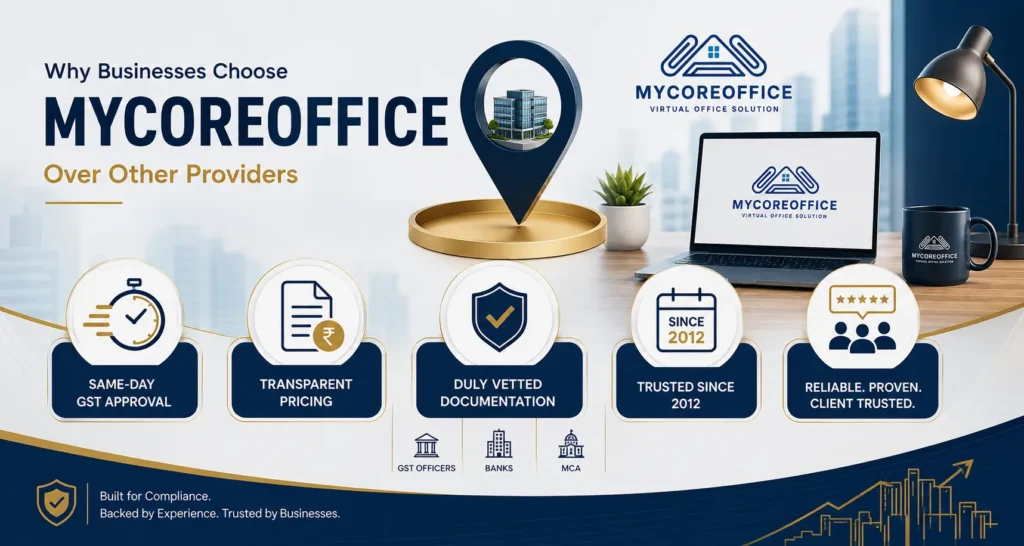
There are a lot of virtual office providers in India at this point, so it’s fair to ask what actually sets one apart. A few things stand out with MyCoreOffice specifically.
Same-day GST approval is a genuine differentiator – a lot of providers can get you the documents, but actually getting through the registration process quickly depends on how clean and consistent that documentation is, and that’s where they’ve focused. Pricing is transparent, with no hidden charges tacked on later, which matters more than people expect once they’ve been burned once by a provider that surprises them with extra fees for documentation updates or mail forwarding. The documentation itself is duly vetted, meaning it’s built specifically to survive the scrutiny of GST officers, banks, and the MCA – not just to look official.
There’s also the track record. MyCoreOffice has been operating since 2012, which puts it ahead of a lot of newer players that have popped up in just the last few years riding the coworking boom. And clients have pointed to the reliability of the platform and how it’s simplified otherwise messy compliance processes – the kind of feedback that matters more than marketing copy.
Frequently Asked Questions
What is a virtual office?
A virtual office is a service that lets you use a professional business address without physically operating from that location. It’s commonly used for GST registration, company registration, and maintaining a credible business presence while keeping costs low.
Can I use a virtual office address for GST registration?
Yes. As long as the provider gives you proper supporting documents – NOC, rent agreement, and utility bill – a virtual office address is fully valid for GST registration.
What documents will I get for GST registration?
You’ll typically receive a No Objection Certificate, a rent agreement, and a utility bill tied to the address, along with signage proof where required.
Is a virtual office address valid for company registration?
Yes, virtual office addresses can be used as the registered office address for company incorporation with the MCA, provided the documentation is in order.
How much does a virtual office cost in India?
Pricing generally starts around ₹999/month for a basic virtual office valid for GST, MCA, and banking. Coworking and private office plans cost more, depending on the level of physical access included.
How long does GST registration take with a virtual office?
With properly vetted documentation, it can be approved the same day, without requiring a physical inspection visit.
Can I use a virtual office for Amazon or Flipkart seller registration?
Yes. It’s commonly used to fulfill Additional Place of Business (APOB) requirements for e-commerce sellers expanding into new states.
What’s the difference between a virtual office and a coworking space?
A virtual office gives you an address for registration purposes without requiring you to physically work there. A coworking plan includes that same registration validity but also gives you actual desk access when you need it.
Founder of Mycoreoffice
MyCoreOffice was founded by Shivani, who brings 11 years of experience across coworking spaces, virtual offices, e-commerce, and real estate. That mix of backgrounds is what shapes the way MyCoreOffice runs – documentation that’s built to actually pass GST and MCA checks, spaces managed with real estate know-how, and a genuine understanding of what e-commerce sellers need when expanding across states. Under her leadership, MyCoreOffice has grown into a presence across 50+ cities, all built around one simple idea – give businesses an address that works when it’s actually tested, not just one that looks good on paper.
About the Author
This guide was put together by the content and compliance team at MyCoreOffice, drawing on direct experience helping startups, freelancers, and e-commerce businesses navigate GST and company registration across India since 2012. The goal is simple: cut through the confusion around virtual offices and give business owners a clear, honest picture of what they’re actually signing up for.
Conclusion
Choosing a virtual office isn’t really about finding the cheapest address on the internet – it’s about finding one that holds up when it actually matters, whether that’s a GST officer reviewing your application, a bank verifying your account, or a marketplace checking your APOB compliance. A MyCoreOffice workspace is built around that exact problem: giving you a real, properly documented business address, fast registration turnaround, and support that doesn’t disappear after you’ve paid. Whether you’re just starting out, expanding into a new state, or trying to get your e-commerce business compliant across multiple regions, it’s worth understanding exactly what you’re getting before you commit – and hopefully, this guide has made that a lot clearer.