
Table of Contents
Summary
If you take away just one thing from everything above, let it be this: a virtual office is not a loophole, not a grey area, and not something you need to feel uneasy about using. It’s a legitimate, well-documented, government-recognized way to register for GST, and thousands of freelancers, startups, and growing businesses across India rely on it every single month without any trouble.
The businesses that run into problems are almost never the ones “using a virtual office” – they’re the ones who picked a provider that cut corners. A mismatched address on one document, an expired utility bill, a vague NOC that never actually mentions GST – these tiny gaps are what cause rejections and REG-03 notices, not the fact that you’re not physically sitting at that address every day. Once you understand that distinction, the whole process stops feeling risky and starts feeling like exactly what it is: paperwork done right.
So here’s the honest, practical takeaway. Know your PPOB from your APOB, don’t get talked into believing “VPOB” is some special government category, keep your three core documents consistent and current, and pick a provider who runs a real, staffed, signed location rather than just a mailbox with a fancy address on it. Do that, and there’s genuinely nothing standing between you and a clean, same-day-to-week GSTIN approval – no inspector drama, no back-and-forth, no wasted weeks.
A virtual office isn’t a shortcut around the system. It’s simply a smarter way to meet the system’s actual requirements – a real address, real documentation, and a provider who’s done this hundreds of times before. Get that part right, and you can register your business, expand into new states, and build the credibility you need, without ever signing a traditional office lease.
Key Takeaways
- Here’s everything worth remembering from this guide, boiled down to what actually matters when you sit down to register:
- A virtual office is completely legal for GST registration in India. There’s nothing hidden or borderline about it – Section 25 and Rule 8 of the CGST Rules only care about proper documentation, not whether you physically sit at that address every day.
- The law behind this isn’t stuck in 2021. The current governing framework is CBIC Instruction No. 03/2025-GST, dated April 17, 2025, which builds on the earlier Circular 161/17/2021. If a provider or an article is only quoting the old circular, they’re not giving you the full picture.
- “VPOB” is not an official government term. It’s shorthand the industry uses once your virtual office address is registered as your PPOB or APOB. Don’t let anyone convince you it’s a separate registration category – it isn’t, and knowing this saves you from unnecessary confusion.
- Three documents make or break your application: a signed, dated NOC that specifically mentions GST use, a rent or leave-and-license agreement that explicitly permits GST registration, and a utility bill dated within the last two months. Get these three to match perfectly, and most of the risk disappears.
- The GST portal now runs an automated risk-scoring system before an officer even sees your file. Mismatched documents, an expired bill, or too many businesses registered at one address are what trip this system – not the virtual office itself. A clean, consistent paperwork trail is your best protection.
- Physical verification isn’t something to panic over. It exists to confirm your address is real and operational, and a provider with genuine signage and an active, staffed location handles it without any drama.
- Rejections almost always trace back to weak documentation, not a flawed concept. Address mismatches, vague NOCs, and outdated bills cause the vast majority of REG-03 notices – all of which are avoidable with the right provider.
- Compliance doesn’t end at approval. Your NOC and agreement need to be renewed, and if your provider ever changes hands or shuts down, updating your GST records promptly protects you from cancellation risk years down the line.
- The cheapest option isn’t always the smartest one. A provider offering a rock-bottom price with no real presence is far more likely to trigger scrutiny than one charging slightly more for a genuine, well-documented location.
- Choosing the right provider is the single biggest factor in how smoothly this whole process goes. Look for a real staffed address, fast document turnaround, transparent pricing, and a track record of clean approvals – providers like MyCoreOffice, with same-day GSTIN support and pre-vetted documentation, are a good benchmark for what “doing this properly” actually looks like.
Introduction
If you’re building a business without a physical office and wondering whether that’s going to be a problem when you sit down to register for GST, here’s the short version: it isn’t, as long as you know what you’re doing. A virtual office is legally valid for GST registration in India, but “legally valid” and “guaranteed to sail through” are two very different things, and most of the confusion online comes from people mixing up the two.
This guide walks through everything – what a virtual office actually is, whether it holds up under GST law, what documents you need, how the newer risk-scoring system on the GST portal works, why some applications get rejected even when the address itself is fine, and what nobody else is really telling you about staying compliant after you’ve already got your GSTIN.
What Is a Virtual Office, Exactly?
A virtual office is a service that gives your business a real, physical business address – usually in a commercial building – without you actually needing to sit there every day. You’re not renting a desk or a cabin. You’re paying for the right to use that address as your registered office address, along with a bundle of supporting services that usually includes mail handling, a call answering service, and access to a meeting room whenever you actually need to meet a client or sign something in person.
It’s become the default choice for a specific set of people: freelancers who don’t want their home address on public GST records, early-stage startups that can’t justify a lease yet, sole proprietors running things out of a spare room, e-commerce sellers who need a presence in multiple states, remote-first businesses, SMEs trying to look more established than a home address suggests, and even NRI founders setting up a base in India without being physically present.
The confusion usually starts when people lump a virtual office in with a coworking space or compare it loosely to just using their home address. They’re not the same thing, and the differences actually matter for GST purposes.
Virtual office vs coworking space vs home address, side by side:
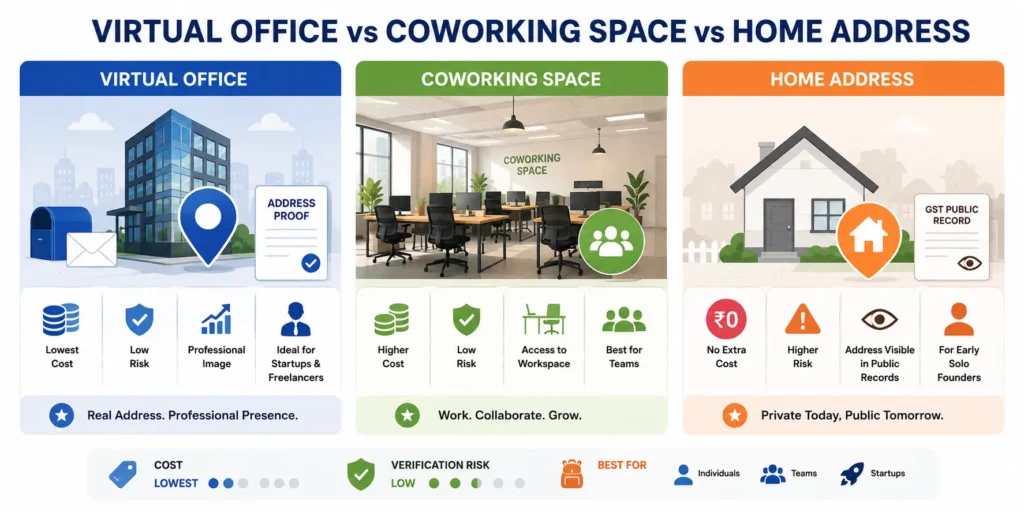
A virtual office is the cheapest of the three and carries low verification risk if you pick a genuine provider, because the address is a real commercial premises backed by proper documentation, even though you’re rarely physically present there. It gives you a professional image and is best suited for startups, freelancers, and businesses expanding into new states.
A coworking space costs more because you’re actually paying for desk or seat access, and it also carries relatively low verification risk since it’s a functioning, staffed location – best for teams that want an actual place to work occasionally, not just an address.
Using your home address costs nothing extra but carries higher scrutiny in some cases, especially if your locality is zoned residential, and it exposes your personal address on public GST records. It’s fine for very early solo founders who aren’t worried about privacy, but it’s the option most people eventually move away from.
Is a Virtual Office Legal for GST Registration in India?
Yes – and this isn’t a grey area or a workaround, it’s built into the law. Section 25 of the CGST Act governs GST registration, and nowhere in that section, or anywhere else in the CGST Act or CGST Rules, is there a requirement that you own or physically occupy your registered premises. The law defines your Principal Place of Business under Section 2(89) simply as the address specified as your principal place of business on your registration certificate – it doesn’t dictate what kind of premises that has to be.
What the law does care about is documentation. Rule 8 of the CGST Rules lays out exactly what you need to submit as proof of your Principal Place of Business, and that requirement is the same whether the premises is owned, rented, or shared under a consent arrangement – which is exactly the category a virtual office falls under.
The CBIC has never issued anything prohibiting virtual offices. In fact, Circular 161/17/2021 explicitly recognizes shared and consent-based premises, including virtual office arrangements, as valid for GST registration, provided the documentation is in order. And here’s something most articles you’ll find on this topic miss entirely: that circular from 2021 isn’t the last word anymore. The CBIC issued Instruction No. 03/2025-GST on April 17, 2025, which supersedes the earlier Instruction 03/2023-GST and lays out clearer, more uniform guidelines specifically for PPOB documentation across rented and shared spaces, including virtual offices. If you’re reading a guide that only quotes the 2021 circular and stops there, you’re reading something that’s a couple of years out of date on the actual governing framework.
So to put it plainly: a virtual office is legal for GST registration. The only thing that puts your registration at risk is sloppy or inconsistent documentation, not the fact that you’re using a virtual office in the first place.
PPOB, APOB, and “VPOB” – Getting the Terms Straight
This is where a lot of business owners get genuinely misled, not by the government, but by marketing.
Your Principal Place of Business, or PPOB, is the main registered address for your GSTIN in a particular state. It’s where all your official GST correspondence, notices, and refund orders go. Every business needs exactly one PPOB per state it operates in.
If you’re already registered under a GSTIN in a state and you want to add another location – say a second virtual office in the same state – that becomes an Additional Place of Business, or APOB, added under your existing GSTIN through a core field amendment on the GST portal.
Now here’s the part almost nobody explains clearly: you’ll see a lot of virtual office providers advertise something called “VPOB,” short for Virtual Place of Business, as if it’s an official government category. It isn’t. There’s no such term anywhere in the CGST Act or CGST Rules. It’s industry shorthand that providers use to describe a virtual office address once it’s been registered as your PPOB or APOB. It works exactly like a normal PPOB or APOB on your GST certificate – same legal standing, same GSTIN – but the term itself is marketing language, not law. Knowing this distinction matters because it stops you from assuming there’s some separate, special registration category you need to apply for. You don’t. You’re just registering a PPOB or APOB, and the address happens to be a virtual office.
Documents You Need for GST Registration with a Virtual Office
This part is genuinely simple once you know what to ask your provider for. You need three documents, and they all have to say the same thing.
The No Objection Certificate, or NOC, is issued by your virtual office provider on their official letterhead. It authorizes you to use their address for GST registration purposes specifically – a generic NOC that doesn’t mention GST use at all is one of the more common reasons applications get flagged. It needs to be signed, dated, and should clearly state your company name, the address, and the period for which you’re allowed to use it.
The rent agreement, sometimes called a leave and license agreement, is your formal right to use the premises. It should ideally cover a minimum tenure – most providers use 12 months – and it needs to explicitly permit the address to be used for GST registration. An agreement that’s vague on this point can create problems later even if everything else checks out.
The utility bill – electricity, water, or a property tax receipt – proves the address is a real, functioning location. This is the document people trip up on most often because it has a recency requirement: it generally needs to be dated within two months of your application. An outdated bill is one of the fastest ways to get flagged, even when nothing else is wrong.
Alongside these three, you’ll also need your own KYC documents: PAN card, Aadhaar card, a passport-size photograph, and if you already have a registered entity, your certificate of incorporation or partnership deed.
One thing worth doing before you even apply: cross-check that the address on all three provider documents matches exactly – same spelling, same floor number, same building name. Address mismatch between documents is, by a wide margin, the single most common reason applications run into trouble.
Step-by-Step: Registering for GST Using a Virtual Office
Once your documents are sorted, the actual process is fairly mechanical. You choose a compliant virtual office provider, get your NOC, agreement, and utility bill from them, and then fill out Form GST REG-01 on the GST portal, uploading your documents and KYC details alongside it. The portal generates an ARN so you can track your application. From there, one of three things happens: your application gets approved outright, you receive a query in the form of a REG-03 notice asking for clarification, or your application gets flagged for physical verification. If everything goes smoothly, most people receive their GSTIN within three to ten working days from complete document submission.
How the GST Risk-Scoring System Actually Works in 2026
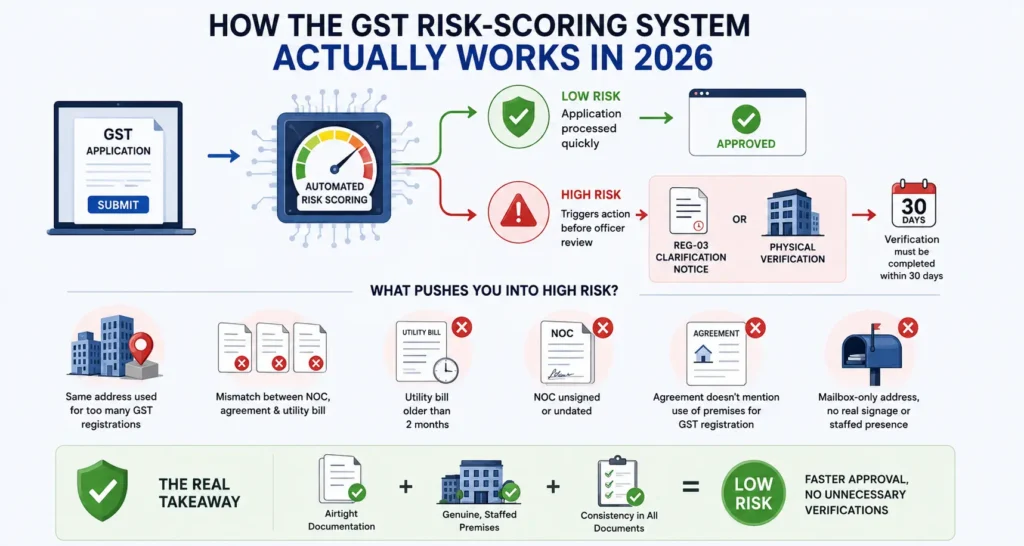
This is the part almost no one writing about this topic explains properly, and it’s probably the most useful thing you’ll take away from this guide.
The GST portal doesn’t send every application straight to a human officer anymore. Before an officer ever looks at your application, the system runs it through an automated risk-scoring process. If your application looks clean, it moves through quickly. If it looks risky, the system automatically triggers either a REG-03 clarification notice or a mandatory physical verification, and that verification has to be completed within 30 days.
So what actually pushes an application into the high-risk category? A handful of things come up again and again: the same address being used for an unusually large number of GST registrations, mismatches between the address on your NOC, agreement, and utility bill, a utility bill that’s older than two months, an NOC that’s unsigned or undated, or an agreement that never explicitly says the premises can be used for GST registration purposes. Providers who operate as little more than a mailbox service – no real signage, no staffed presence – tend to trigger this far more often than providers running an actual functioning office.
The practical takeaway here is that the system isn’t scoring you on whether you use a virtual office. It’s scoring the quality and consistency of what’s behind that virtual office. Choose a provider whose documentation is airtight and whose location is a genuine, staffed premises, and your risk score stays low regardless of the fact that you’re not physically sitting there every day.
What Happens During GST Physical Verification
Physical verification exists under Rule 25 of the CGST Rules, which was significantly expanded through Notification No. 38/2023-CT dated August 4, 2023. This widened the circumstances under which verification can happen, so as of 2026 it can occur at two different points – before your registration is granted, or after it’s already been approved.
Pre-registration verification usually happens when your application is flagged as high-risk by the scoring system described above. Post-registration verification can be triggered later on for different reasons: a notice sent to your registered address comes back undelivered, someone files a complaint about the address, you’ve gone an extended period without filing returns, or your registration is being reviewed as part of a cancellation process.
When an officer actually shows up, they’re checking whether the premises is real, whether it’s operational, and whether it matches what you declared. Visible signage with your business name matters here more than people realize – it’s often the simplest, fastest way an officer confirms a location is legitimate rather than a mailbox. The officer’s findings get recorded in Form GST REG-30, uploaded to the GST portal. If the response is unsatisfactory, the application can be rejected, or an existing registration can be cancelled, and you’d need to reapply with corrected documentation or a different address.
Why GST Registration Actually Gets Rejected When Using a Virtual Office
It’s worth being direct about this: virtual offices themselves are not the reason applications get rejected. Document quality is. The recurring causes are address mismatch between the NOC, agreement, and utility bill; an expired utility bill; a weak or unsigned NOC; an agreement that doesn’t clearly permit GST use; residential zoning conflicts in certain localities; and – this one catches people off guard – too many GST registrations already sitting at the same address, which raises a red flag even if your own paperwork is perfect.
If your documents look questionable to the system, you’ll get a REG-03 notice, which is simply a clarification request asking for additional proof – this could be a better copy of your NOC, a more recent utility bill, photographs of the premises, or an explanation of your business activity. You typically have seven working days to respond, and a prompt, complete response is usually enough to move things forward without further delay.
Does It Matter Which State You’re Registering In?
This is something you won’t find covered anywhere else, but it’s genuinely useful: GST is administered jointly by the Centre and the states, and in practice, different state GST departments apply different levels of strictness when it comes to verifying virtual office addresses. Karnataka, given how many startups and virtual office providers operate out of Bangalore, tends to be relatively used to processing these applications smoothly, provided documentation is solid. Maharashtra, particularly Mumbai, sees heavy volume in commercial hubs like BKC and tends to scrutinize document consistency closely given how many registrations pass through those addresses. Delhi NCR, spanning Delhi, Gurgaon, and Noida, has more variation because it spans multiple jurisdictions with slightly different local practices. Telangana and Tamil Nadu, centered around Hyderabad and Chennai, are generally straightforward as long as the provider is established and reputable.
None of this changes the underlying law, but it’s a useful practical filter when you’re choosing a city and a provider – an established provider with a track record in that specific state’s GST office tends to make the process noticeably smoother.
What a Virtual Office Actually Costs
Pricing varies a fair bit depending on the city and what’s bundled in. As a rough guide, standard plans that cover just a business address with GST-compliant documentation run somewhere between ₹999 and ₹3,000 a month. Premium addresses in prime commercial districts – think BKC in Mumbai, Connaught Place in Delhi, or MG Road in Bangalore – tend to push past ₹4,000 a month, especially once you add meeting room access, call handling, or coworking privileges on top.
Here’s the part that’s genuinely useful and that pricing pages tend to gloss over: cost and rejection risk aren’t unrelated. A provider offering an address at rock-bottom pricing with no visible operational presence is very often just running a mailbox service – no signage, no staff, minimal documentation support. That’s exactly the profile that trips the risk-scoring system and draws physical verification. A provider charging a bit more but maintaining an actual staffed, signed location with a track record of clean documentation is, in practical terms, cheaper in the long run, because a failed registration costs you time, a reapplication, and possibly weeks of delay in getting your business operational. When you’re comparing prices, it’s worth asking directly: is this a real, staffed location, or just an address on paper?
Virtual Offices for E-Commerce Sellers Selling Across States
If you’re selling on Amazon, Flipkart, or Meesho, this section matters more to you than almost anyone else reading this. Marketplace fulfilment centres are spread across multiple states, and many of these platforms require you to hold a valid GSTIN in each state where you’re storing or selling inventory.
The decision usually comes down to one simple question: do you already have a GSTIN in that state? If you don’t, you need a new PPOB registered in that state, and a virtual office is typically the fastest, most cost-effective way to get one without setting up a physical branch. If you already hold a GSTIN there and just need an additional location – say a second fulfilment address in the same state – that’s an APOB added to your existing registration through a core amendment, not a fresh PPOB. Getting this distinction right upfront saves you from filing the wrong type of application and having to correct it later.
Staying Compliant After You’ve Got Your GSTIN
This is the section most guides skip entirely, and it’s arguably the most important one for anyone actually running a business rather than just registering one.
Getting your GSTIN approved isn’t the finish line. Your NOC and rental agreement typically need to be renewed annually, and letting them lapse without updating your provider or your GST records creates a real vulnerability – if a notice ever gets sent to that address and your agreement has technically expired, that can trigger exactly the kind of scrutiny that leads to cancellation. If your virtual office provider shuts down or changes ownership partway through the year, you need to update your GST records with a new address promptly rather than leaving your registration pointing to a location that no longer exists or no longer has your consent documentation on file.
There’s also a longer-term risk that catches people off guard: under Rule 21 and Rule 21A of the CGST Rules, a registration can be cancelled if the premises is later found to be non-existent or if the taxpayer is found not to be conducting business from the declared address – and this can happen even years after your initial approval, if the underlying documentation trail isn’t kept current. Treating your virtual office documentation as a one-time task at registration, rather than something you check in on annually, is one of the quieter risks in this whole process.
How to Actually Choose a Compliant Provider
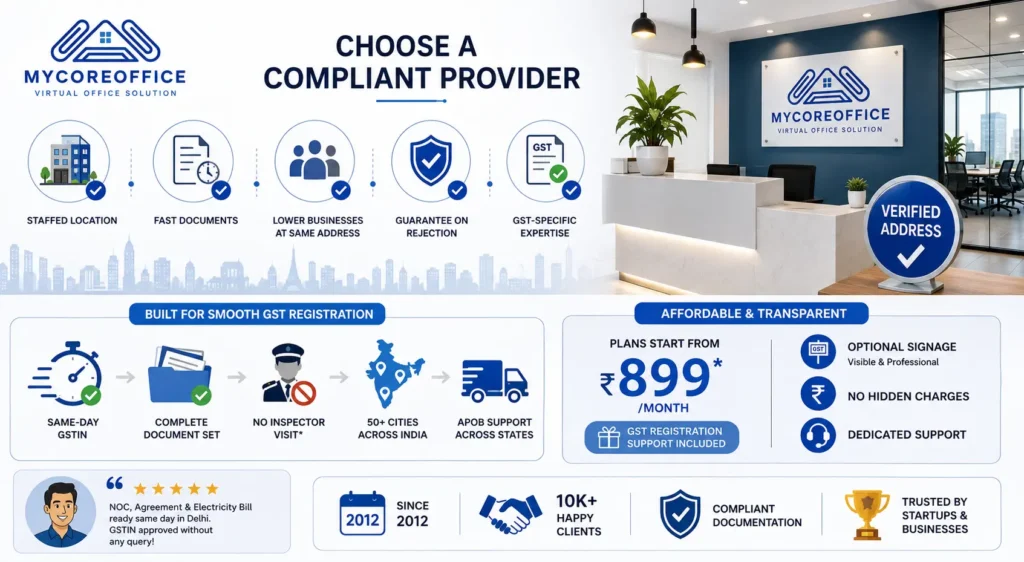
A few practical filters go a long way here. Look for a location that’s genuinely staffed with visible signage, not just a mailing address on a spreadsheet. Ask how quickly they can turn around your documents – reputable providers usually manage this within 24 to 72 hours. Ask, directly, how many other businesses are already registered at that exact address; a lower number generally means lower scrutiny risk for you. Check whether they offer any kind of guarantee – some providers will re-issue corrected documents or offer a refund if your registration gets rejected due to a documentation issue on their end, which is a reasonable sign they stand behind their process. And ideally, pick a provider who deals with GST-specific documentation regularly, not a generic mail-forwarding service that happens to also offer a business address.
If you want an example of what this actually looks like done well, MyCoreOffice is worth pointing to. They’ve been running virtual office and coworking solutions since 2012, which is a fairly long track record in a space where a lot of providers are only a couple of years old, and they now operate across 50-plus cities in India, including Delhi, Mumbai, Gurugram, Noida, and Bangalore. A few things stand out about how they run this specifically for GST registration.
They’ve built their process around same-day GSTIN turnaround, with documentation prepared to avoid the back-and-forth that usually slows things down – no inspector visits required in the straightforward cases, which matters a lot if you’re trying to get your business operational quickly rather than waiting weeks. Every plan comes with the full document set you actually need – NOC, rent agreement, and a current electricity bill – pre-vetted for the address, which directly addresses the mismatch and recency issues that cause most rejections in the first place. They’re also upfront about being MSME-focused, meaning their documentation and process are built around the reality of how proprietors, freelancers, and small startups actually operate, rather than a one-size-fits-all corporate template.
Pricing is transparent and sits at the affordable end without tipping into the “mailbox-only” risk zone – virtual office plans start around ₹899 to ₹999 a month depending on the city, with GST registration support bundled in, and no hidden charges on top. They also offer optional signage – a permanent sticker signage or a more premium framed version – which is a small detail, but a genuinely useful one, since visible signage at the premises is exactly what a GST officer looks for during physical verification if it’s ever triggered. For sellers on Amazon and Flipkart, they specifically support APOB registrations across states, which covers the multi-state GSTIN need that a lot of generic providers don’t handle well.
What’s reassuring reading through their client feedback is that it lines up with what actually matters in this process – one founder mentioned getting their NOC, rent agreement, and electricity bill ready the same day for a Delhi registration, with the GSTIN approved without a single department query, which is precisely the outcome good documentation is supposed to produce. If you’re evaluating providers using the checklist above – staffed presence, fast documentation, transparent pricing, and support for the specific registration type you need – MyCoreOffice is a solid benchmark to compare others against.
Weighing the Pros and Cons
The upside is significant: real cost savings compared to leasing physical space, a credible commercial address instead of a home address, the ability to expand into new states without opening a physical branch, and general flexibility that suits how remote and hybrid businesses actually operate today. The downside is mostly about diligence rather than the concept itself – if you go with a non-compliant or low-effort provider, you’re exposed to verification risk, address-sharing issues if too many businesses sit at the same location, and the ongoing responsibility of keeping your documentation renewed rather than treating it as a one-time task.
Frequently Asked Questions
Is a virtual office valid for GST registration in India?
Yes. GST law under Section 25 and Rule 8 of the CGST Rules doesn’t require ownership or physical occupation of your registered premises – it requires proper documentation, which a genuine virtual office provider supplies.
What documents are required for GST registration with a virtual office?
A No Objection Certificate, a rent or leave-and-license agreement, and a recent utility bill from the provider, along with your own PAN, Aadhaar, photograph, and incorporation documents if applicable.
How much does a virtual office cost for GST registration?
Typically between ₹899 and ₹3,000 a month for standard plans, rising to ₹4,000 or more for premium addresses in prime commercial districts.
Can a GST officer reject a virtual office address?
Yes, but almost always because of documentation issues – mismatched addresses, expired utility bills, or unclear NOCs – not because the address is a virtual office.
How many GST registrations can be done on one virtual office address?
There’s no fixed legal cap, but an unusually high number of registrations at the same address is one of the factors that can raise your risk score on the GST portal.
What is VPOB in GST?
It stands for Virtual Place of Business, but it’s industry terminology used by providers, not an official term found in the CGST Act or Rules. Once registered, it functions exactly like a normal PPOB or APOB.
What happens if GST registration is rejected due to virtual office issues?
You can reapply with corrected documentation, ideally after switching to a more established provider if the rejection stemmed from weak or non-compliant paperwork.
Can I use a virtual office for GST registration as an e-commerce seller?
Yes, and it’s one of the most common use cases, particularly for sellers who need a PPOB or APOB in states where their marketplace fulfilment centres are located.
Is a virtual office better than using a home address for GST registration?
For most businesses, yes – it keeps your personal address off public records, avoids potential residential zoning complications, and presents a more professional image, generally at a modest monthly cost.
A virtual office is a legitimate, well-established route to GST registration, not a workaround or a grey-area trick. The businesses that run into trouble aren’t the ones using virtual offices -they’re the ones using a provider who cuts corners on documentation. Get the paperwork right, pick a provider with a real, staffed presence, and treat compliance as something you maintain rather than something you finish on registration day, and there’s no real reason a virtual office should hold your business back.
Founder of Mycoreoffice
MyCoreOffice was founded by Shivani, who brings 11 years of experience across coworking spaces, virtual offices, e-commerce, and real estate. That mix is what actually shapes how the company operates – documentation built to genuinely pass GST and MCA checks, spaces backed by real estate know-how, and a real understanding of what e-commerce sellers need when expanding across states. Under her leadership, MyCoreOffice has grown into a presence across 50+ cities, all built around one simple idea: give businesses an address that works when it’s actually tested, not just one that looks good on paper. It’s that kind of grounded, experience-led thinking that makes MyCoreOffice a name you can genuinely rely on.
About the Author
This guide was put together by the content and compliance team at MyCoreOffice, drawing on direct experience helping startups, freelancers, and e-commerce businesses navigate GST and company registration across India since 2012. The goal is simple: cut through the confusion around virtual offices and give business owners a clear, honest picture of what they’re actually signing up for.
Conclusion
At the end of the day, using a virtual office for GST registration isn’t something you need to overthink or feel unsure about – it’s a legitimate, well-recognized path that works exactly as well as the documentation behind it. The businesses that sail through registration aren’t the lucky ones; they’re the ones who took the paperwork seriously and picked a provider who actually knows this process inside out, rather than one just selling an address on a webpage.
If there’s one thing worth carrying forward from this guide, it’s that the address itself was never really the risk – inconsistent documents, outdated bills, and vague NOCs are what cause trouble, and all of that is entirely avoidable with the right partner. That’s exactly where a provider like MyCoreOffice earns its place, backed by over a decade of hands-on experience and a founder who’s built the entire process around documentation that’s meant to actually hold up, not just look good.
So whether you’re a freelancer registering for the first time, a startup expanding into a new state, or an e-commerce seller chasing your next PPOB or APOB, the path forward is simple: get your documents right, choose a provider you can trust, and register with confidence. Your business deserves an address that works when it’s tested – and that’s exactly what a good virtual office should give you.
For More Info Contact Us.