Table of Contents
Summary
Finding the right virtual office space near you shouldn’t feel like guesswork, but for most people searching “virtual office near me” or “office space near me,” that’s exactly what it becomes. This guide breaks that pattern. You’ll get a real virtual office checklist to verify legitimacy before you pay, a decision framework on when proximity actually matters, an honest cost comparison by city tier, and a clear explanation of how your provider choice affects GST registration approval. Every point here is built to help entrepreneurs, SMEs, and remote teams choose the right virtual office with confidence, avoid common red flags to avoid, and register the right way the first time.
Key Takeaways
- A virtual office gives your business a legal registered address for GST and company registration without the overhead of physical space, a practical fit for startups, freelancers, entrepreneurs, and SMEs.
- Proximity works differently for everyone. E-commerce sellers can pick the nearest virtual office based on price alone, while consultants and remote teams needing regular mail pickup should look for a genuine local business address.
- Verify provider legitimacy before paying. An authentic, signed NOC is your first line of defense, and it directly protects the legal validity of virtual office use for registration.
- Ask for address proof for registration in the form of both a rent agreement and utility bill together. One alone rarely holds up.
- Check how many other companies already use that address. A saturated address is one of the biggest red flags to avoid in this entire process.
- Request a physical inspection or video walkthrough. This is a simple way to evaluate virtual office services before you commit to anything.
- Read the cancellation terms closely so you know exactly how to select a provider you can exit cleanly if needed.
- Look beyond the advertised monthly rental cost. A proper cost comparison includes setup fees, GST on the service, and renewal increases.
- A weak provider directly risks a GST REG-03 rejection, so provider choice is a compliance decision, not just a pricing plans decision.
- Score every provider on documentation speed, address quality, support responsiveness, transparent pricing, and compliance record before signing.
Introduction
Search “virtual office near me” or “office space near me” and you get thousands of listings but almost zero real guidance on how to actually evaluate virtual office services. This guide fixes that gap for startups, freelancers, small business owners, solopreneurs, remote teams, entrepreneurs, SMEs, e-commerce sellers, and consultants looking for a virtual office space near you.
Quick answer: A virtual office is right for you if you need a legal registered office address for GST or company registration without renting physical space, and it works best when you verify documentation, compare virtual office providers honestly, and understand exactly how your choice affects GST approval before you sign anything.
What a Virtual Office Actually Means for Your Business
A virtual office gives you a real, legal business address (also called a registered office address or virtual business address) that you can use for company registration, GST filing, and business correspondence, without physically working from that location. It fits neatly into remote work and hybrid work, where a physical office sits unused most days but you still need a prestigious address on your paperwork to maintain a strong professional image.
What Services Actually Come With a Virtual Office
A good virtual office should function like an actual extension of your business. Most providers bundle in a phone answering service or virtual receptionist, so client calls get handled properly instead of going to voicemail. You’ll typically get day office or meeting room access whenever you need face time with a client, plus basic administrative support for the small logistics you’d rather not manage yourself.
Your virtual office address can also double as your professional address for business cards, letterheads, and invoices, quietly reinforcing business credibility every time a client looks at your details.
Office Space Near Me: Does Proximity Actually Matter?
You’ve probably read this line a dozen times: “location doesn’t matter for a virtual office.” That advice is built around US business norms and only tells half the story for Indian founders.
A better approach is to ask how you actually use your business, not chase a nearest virtual office purely out of habit.
If you never plan to step foot in the office, proximity genuinely doesn’t matter. Base your decision on price, city tier, and provider reliability instead.
If you need occasional physical access, a nearby virtual office location in your city genuinely saves time. A provider two hours away is fine on paper until the day you actually need to walk in.
If you expect regular mail pickup or frequent in-person contact, treat a local business address and prime business location as real requirements, not nice-to-haves. Look for a virtual office in your city, ideally near an established commercial hub, so client visits and courier pickups stay convenient.
There’s no universal rule here. Match your choice to how often you’ll realistically show up.
Virtual Office Checklist: How to Select a Provider You Can Trust
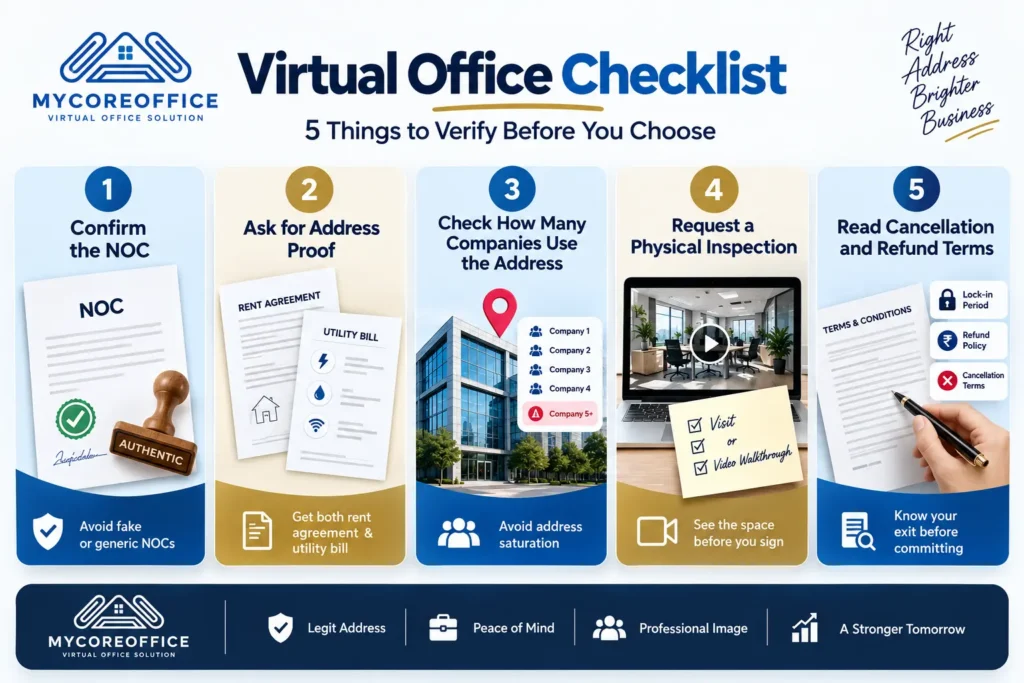
This is the part almost no competitor covers with real detail. Here are the things to consider before choosing, laid out as five concrete checks so you can verify provider legitimacy yourself instead of taking anyone’s word for it.
1. Confirm the NOC is authentic. A vague or generic NOC threatens the legal validity of virtual office use down the line, and it’s the fastest way to spot provider fraud.
2. Ask for address proof for registration: rent agreement and utility bill together. One without the other rarely satisfies registration filings. If a provider hesitates, that’s a factor to consider seriously.
3. Find out how many companies already use that address. Address saturation is a red flag to avoid; five or more existing registrations invites extra scrutiny from GST officers.
4. Request a physical inspection or video walkthrough before signing. This single step is the easiest way to evaluate virtual office services honestly.
5. Read the cancellation and refund terms closely. Hidden lock-in periods and non-refundable setup fees are common, so know your exit before you commit.
Run any provider through this checklist and you’ll sidestep almost every complaint people post online after the fact.
Real Cost Comparison: Virtual Office Price by City Tier
The virtual office price and monthly rental cost you see advertised is rarely the full picture. A proper cost comparison needs to include setup fees, GST on the service, courier charges, and renewal increases, not just the headline number.
| City Tier | Typical Monthly Rental Cost | Setup Fee | Commonly Hidden Charges |
| Tier 1 (Delhi, Mumbai, Bangalore) | Higher, premium commercial addresses | One time, sometimes waived on annual plans | Courier handling, GST on service, steep renewal hikes after year one |
| Tier 2 cities | More affordable virtual office, budget friendly office solution pricing | Usually lower or negotiable | Meeting room hourly rates, mail forwarding charges |
Always ask for the full cost stack upfront. Providers rarely volunteer the renewal number, and that’s usually where the real value for money gets eroded.
Virtual Office vs Coworking vs Shared Office, Decided by Use Case
Forget generic pros and cons of virtual office lists. Here’s what actually fits which situation, as a real factor to consider rather than a checklist to skim.
Best for GST registration and compliance only: A pure virtual office. No desks or meeting rooms needed, just a clean, verifiable registered address.
Best for occasional physical workspace: A hybrid of a virtual office address plus pay-per-use coworking space or shared office access, so you’re not paying for a desk you barely use, an easy way to save on overhead costs.
Best for networking and community: A full coworking space membership, where the value is the people around you, not just the address.
Virtual Office vs Physical Office: Which One Actually Makes Sense
This isn’t really a debate, it’s a question of business stage. A physical office earns its overhead once you have a team in one place daily and frequent client visits. A virtual office makes sense when your work isn’t location-dependent but you still need a legitimate commercial address.
The difference between a virtual office and a business center comes down to commitment: a business center means paying for square footage whether you use it or not, while a virtual office means paying only for the address and services tied to it.
Why Your Business Address Shapes Client Impression
A prime business location tied to a recognizable commercial hub shifts client impression before you’ve said a word, reinforcing business credibility and professional image from the first interaction. This is exactly why provider reputation and customer reviews are worth checking before signing. A reliable service provider will have a visible track record you can verify, which tells you more than the price alone ever will.
How Your Choice Affects GST Registration Success
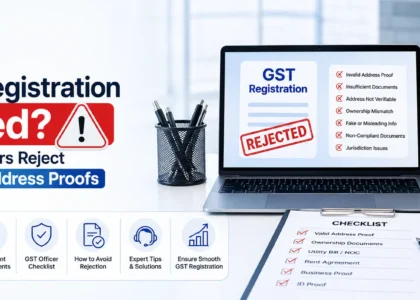
A poor provider choice doesn’t just waste money, it can directly cause a GST REG-03 rejection. The usual culprits are a saturated address, a weak NOC, and mismatched documents. GST officers are trained to flag exactly these inconsistencies. If you want the full breakdown of what causes these rejections, that’s covered in more depth in our dedicated post on GST registration rejection reasons.
When a Virtual Office Helps You Scale
As your business grows, a virtual office shifts from a cost-saver to a strategy. Founders use it to establish business presence in a new city without opening a full physical branch there. If you’re planning to expand to a new city, a local virtual office lets you test the market and register there before committing to real infrastructure.
This is exactly how businesses scale operations without letting costs scale alongside them, building credibility, maintaining compliance, and helping you get approved faster for GST or MCA filings.
A Quick Self-Scoring Framework to Evaluate Any Provider
Score every provider you’re considering honestly across five factors, rather than going with whoever ranks first in search.
Documentation speed. How fast can they actually hand over the NOC and rent agreement you need?
Address quality. Is it a genuine commercial address, and how saturated is it with other registered businesses?
Support responsiveness. Do they answer clearly and quickly, or do you have to chase them?
Transparent pricing. Did they lay out the full cost stack without you asking three times?
Compliance track record. Can they point to real businesses that registered and filed GST cleanly using their address?
Providers who score well across the board are usually worth the slightly higher price. Ones who dodge even one of these questions are telling you exactly what to expect later, no matter how attractive the pricing plans look upfront.
A Few Compliance Terms Worth Knowing
A few terms come up repeatedly once you’re dealing with the Ministry of Corporate Affairs. Your business incorporation address is officially recorded during company registration and needs to match your documentation exactly for MCA compliance. When you file for ROC filing, the registrar checks this address against your submitted proof, which is exactly why address verification failure trips up so many new businesses. A fake virtual office, delayed documentation, or mismatched address proof are the most common reasons applications bounce back for correction.
Frequently Asked Questions
Is a virtual office legal for company registration in India?
Yes. A virtual office is legal for company registration and GST registration in India, provided the provider supplies genuine registered office proof, including a valid NOC, rent agreement, and utility bill.
How much does a virtual office cost per month in India?
Costs vary by city tier. Tier 1 cities like Delhi, Mumbai, and Bangalore run higher due to premium commercial addresses, while Tier 2 cities offer more budget friendly pricing. Always ask for the full cost including setup fee and renewal terms.
What documents are required for virtual office GST registration?
You typically need the NOC for virtual office use, a rent agreement, and a utility bill matching the registered address.
How long does it take to get virtual office documents for GST?
This depends on the provider. Ask upfront about document turnaround time, and treat unusual delays as a red flag before you sign.
Can I use a virtual office address for multiple cities?
Generally, you need a separate registered address in each state or city where you want GST registration, so most businesses use a different provider per location.
Quick Recap
Decide how often you’ll realistically need physical access, and choose proximity based on that.
Run every provider through the verification checklist before paying anything.
Compare the full cost, not just the advertised monthly rental cost.
Match virtual office, coworking, or shared office to your actual use case.
Understand that provider choice directly affects your GST registration outcome.
Score any provider honestly before committing.
Once you’re ready, explore virtual office plans that fit your city and business stage, or check available city landing pages for verified addresses near you.
About the Founder
MyCoreOffice was founded by Shivani, who’s spent the last 11 years moving between coworking spaces, virtual offices, e-commerce, and real estate, not as separate chapters, but as one continuous education in what businesses actually need when they’re trying to grow.
That background shows up in how the company runs. It’s why documentation here is built from the start to hold up under real GST and MCA scrutiny, not just look presentable in a folder. It’s why the spaces are backed by genuine real estate know-how instead of guesswork. And it’s why there’s a real, working understanding of what e-commerce sellers run into the moment they start expanding into new states, because that’s a problem Shivani has watched and helped solve up close, not just read about.
Under her, MyCoreOffice has grown to a presence in 50+ cities across India, but the idea driving all of it hasn’t changed: give businesses an address that actually works when someone checks it, not one that just looks good on a website.
About the Author
This article is brought to you by the content team at MyCoreOffice, a virtual office space provider helping startups, freelancers, entrepreneurs, and SMEs across India find registered addresses that are genuinely GST and MCA compliant. Our team works closely with founders every day, which means we see firsthand what actually causes registration delays, GST rejections, and provider headaches, and we write our guides to help you avoid exactly those mistakes.
If you have questions about virtual office plans, GST registration support, or choosing the right address for your business, our team at MyCoreOffice is here to help you get it right the first time.
Conclusion
Finding the right virtual office space near you doesn’t have to be a gamble. The real difference between a smooth registration and a stressful one comes down to a few things you can control: matching your provider to how you actually use your business, running the verification checklist before you pay, comparing the full cost upfront, and understanding that provider choice directly shapes your GST outcome.
A good virtual office should build credibility, keep you compliant, and save on overhead costs, not create new problems down the line. When you’re ready, explore virtual office plans built for your city and business stage, backed by verified addresses and transparent pricing from the start.
For More Info Contact Us