
Table of Contents
Summary
An unregistered rent agreement is a normal, accepted route for GST registration in Karnataka. It just needs one extra paper: a copy of the landlord’s identity proof. The real risks sit elsewhere, such as the wrong stamp duty for an office, rent written as a yearly figure, mismatched names, and a landlord who refuses to share an ID. This guide walks through each one so you can fix it before you file.
Key takeaways
- Unregistered is accepted. CBIC Instruction No. 03/2025-GST accepts an unregistered rent or lease agreement with one ownership document and the lessor’s identity proof.
- Registered needs less. A registered agreement needs the ownership document only, with no lessor ID.
- Four words, four meanings. Registered, stamped, notarised and valid are different things. GST asks for none of the extras.
- The law says “exceeding one year”. Section 17(1)(d) of the Registration Act is about leases exceeding one year, from year to year, or reserving a yearly rent. It does not say “more than 11 months”.
- Write rent monthly. A yearly rent clause can pull a short lease into the registration net.
- Stamp duty differs for offices. The ₹500 cap belongs to residential leases up to one year. Commercial leases fall under a different article without that cap.
- The Karnataka Rent Act is not a catch all. It excludes non residential premises, except small commercial spaces up to 14 square metres.
- Name match wins files. The owner’s name must line up across the agreement, ownership proof and lessor ID.
- Reply, do not argue. If an officer asks you to register the agreement, answer politely in REG-04 and cite the instruction.
- Register anyway in some cases. Longer leases, stronger evidence in disputes and a calmer landlord relationship are good reasons.
Introduction
Picture this. You found a small office in Whitefield or a shop in Jayanagar. The landlord is happy to sign, but he says, “Let us keep it 11 months. No registration, no headache.” Then you remember your GST application is waiting, and a quiet worry creeps in. Will the officer reject it because the agreement is unregistered?
The short answer is no not, for that reason. However many traps hide around that paper and most online guides miss them. This guide shows you what GST accepts, what Karnataka law actually says, how stamp duty can trip you and how to build a file that holds up. Remember GST rules are strict Karnataka law is clear stamp duty can be tricky and a well‑built file is essential.
Quick answer: is an unregistered rent agreement valid for GST registration in Karnataka?
Yes. Under CBIC Instruction No. 03/2025-GST, an unregistered rent or lease agreement is accepted when it comes with one ownership document of the lessor and a copy of the lessor’s identity proof, while a registered agreement needs no lessor ID. A standard 11 month lease in Karnataka does not need registration for GST. Fix the common gaps, such as the lessor ID, the right stamp duty and matching names, and your agreement will do its job.
What CBIC Instruction No. 03/2025-GST says about your rent agreement
The CBIC Instruction No. 03/2025-GST of 17 April 2025 tells officers what to accept as proof of your principal place of business. For rented premises, you have three simple paths:
- Registered agreement: The agreement plus one ownership document of the lessor. No lessor ID.
- Unregistered agreement: The agreement, one ownership document and a copy of the lessor’s identity proof.
- Utility bill in your name: If the electricity or water bill is in your own name, that bill plus the agreement is enough, with no extra lessor documents.
An ownership document can be a property tax receipt, a municipal khata copy, an electricity or water bill, or another paper that shows ownership.
Other situations are also covered. If a spouse or relative owns the space, you need a plain paper consent letter, the consenter’s identity proof and one ownership document. If you have no agreement at all, an affidavit along with an ownership document of the lessor is sufficient.
Officers may ask only for documents listed in FORM GST REG-01. For the full list of what they cannot ask, see our guide on why GST applications get rejected in Bangalore.
Registered, stamped, notarised, valid: four words that get mixed up
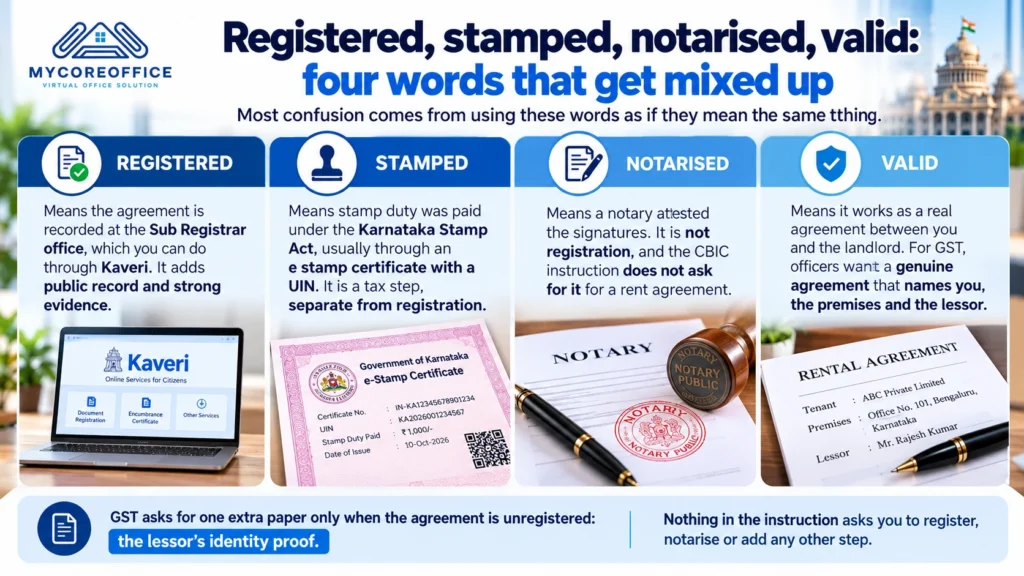
Most confusion comes from using these words as if they mean the same thing.
- Registered means the agreement is recorded at the Sub Registrar office, which you can do through Kaveri. It adds public record and strong evidence.
- Stamped means stamp duty was paid under the Karnataka Stamp Act, usually through an e stamp certificate with a UIN. It is a tax step, separate from registration.
- Notarised means a notary attested the signatures. It is not registration, and the CBIC instruction does not ask for it for a rent agreement.
- Valid means it works as a real agreement between you and the landlord. For GST, officers want a genuine agreement that names you, the premises and the lessor.
GST asks for one extra paper only when the agreement is unregistered: the lessor’s identity proof. Nothing in the instruction asks you to register, notarise or add any other step.
The Karnataka law behind the 11 month habit
Landlords and brokers repeat “11 months, no registration” like a rule. Here is what stands behind it.
Section 17(1)(d) of the Registration Act, 1908 makes registration compulsory for leases of immovable property from year to year, for any term exceeding one year, or reserving a yearly rent. Section 107 of the Transfer of Property Act says the same about how such leases are made. So the legal line is “exceeding one year”, not “more than 11 months”.
That has two practical effects.
A 12 month lease is not a safe middle. Many drafters treat 12 months as the point where registration begins. The safest habits are to stay under one year or to register.
The yearly rent trap. A lease that reserves a yearly rent can fall under compulsory registration even when the term is short. An 11 month lease that reserves a yearly rent may technically need registration. So write your rent as a monthly figure, and avoid phrases like “annual rent of ₹X payable in instalments”. Ask your advocate to confirm the wording.
What if a lease needed registration and did not get it? Then courts may refuse to accept it as evidence of the lease terms, which can hurt you in a dispute with the landlord. That is a separate issue from GST registration, where the instruction accepts an unregistered agreement with the lessor ID.
Does the Karnataka Rent Act, 1999 apply to your office?
Many Karnataka guides cite this Act for every tenancy. For offices, the picture is different.
Section 4(1) of the Karnataka Rent Act says no one may let or take premises on rent except by a written agreement. The line about the rent deed being “in writing and registered” appears in the Statement of Objects and Reasons, not in the operative section.
The Act also leaves out types of premises. According to Section 2(3) it does not include premises used for non purposes unless they are commercial spaces that are fourteen square metres or smaller. It also does not cover premises where the rent’s, above certain limits. Additionally some new buildings are excluded for a period of fifteen years.
So for most Bangalore offices, the Rent Act is not the rule that governs your registration. Treat this section as a guide and not as legal advice. Ask an advocate to confirm how the Act applies to your premises.
Stamp duty in Karnataka: the part most GST guides skip
Stamp duty comes from Article 30 of the Karnataka Stamp Act, 1957, and the rate depends on how you use the space.
- Residential lease up to one year: 0.5% of average annual rent plus advance, premium and fine, with a maximum of ₹500.
- Commercial or industrial lease up to one year: the Karnataka IGR table lists 0.5% on average annual rent, advance, premium and fine, without that cap.
Here is a rough illustration. Say your commercial rent is ₹30,000 a month, with a ₹1.8 lakh deposit. The yearly rent is ₹3.6 lakh, and with the deposit the base is about ₹5.4 lakh. At 0.5%, the duty comes to around ₹2,700, while a residential cap would stop at ₹500. Check the exact figure on the official Kaveri calculator before you pay.
This matters because many office agreements copy a residential template and buy a ₹200 or ₹500 e stamp. The GST portal will not catch that, but an under stamped agreement can cause trouble later, with the landlord, a bank or a court.
A few more points:
- Pay through an e stamp certificate and note its UIN.
- Many websites say physical stamp paper stopped being accepted in July 2025. We found no official notice, so treat that claim as unverified and use an e stamp, which is safe either way.
- Registration fee figures conflict across sources, and one report says fees changed in August 2025. Check Kaveri before you quote any rate.
- Karnataka also changed parts of its Stamp Act in April 2025 to allow electronic payment of duty.
Which agreement route fits you?
Pick the route that matches your premises, then collect that document set.
- You own the space: One ownership document, such as a property tax receipt, khata copy or electricity bill.
- Registered lease: Agreement plus one ownership document of the lessor.
- 11 month unregistered lease: Agreement, one ownership document and the lessor’s identity proof.
- Leave and licence: It usually plays the same role as a rent agreement. Make sure it names the owner, the exact premises and your business, and attach the owner’s ownership proof. Karnataka stamps a letter of licence under a different article, so ask your drafter to confirm the right one.
- Spouse or relative owns it: Consent letter, the owner’s ID and one ownership document.
- No agreement: An affidavit on non judicial stamp paper plus an ownership document of the lessor.
- Coworking or virtual office: These usually run on a service agreement and a consent or NOC route. Officers care most about a real, staffed place. Read our 7 Reasons Officers Reject Virtual Office Address Proofs and see our virtual office in Bangalore page.
The lessor packet and the name match grid
The lessor packet is the small folder that makes an unregistered agreement work. Ask your landlord, politely and early, for:
- A copy of one ownership document, such as a property tax receipt, khata or eKhata copy, or a BESCOM bill in the owner’s name
- A copy of the owner’s identity proof
- A signed copy of the agreement
Tell the landlord why you need the ID, that it goes only on the GST application, and ask for a clear scan. People share more readily when they know the reason.
Now run the name match grid. The owner’s name and the premises address must read the same across:
- The agreement
- The ownership document
- The lessor’s ID
- Your REG-01 application
A spelling slip, a different floor number or a missing initial is enough to bring a query.
One more practical point. The official GST checklist lists the rent or lease agreement upload at 1 MB, and ownership documents like khata, property tax receipt and electricity bill at 100 KB each. It also allows several documents under the principal place of business section. Scan clearly, compress before you upload, and recheck the file after compressing.
How to apply for GST with an unregistered rent agreement in Karnataka
- Choose your route from the guide above.
- Draft the agreement with a monthly rent figure and a term under one year.
- Pay stamp duty on an e stamp certificate under the right category, residential or commercial.
- Sign the agreement with both parties and two witnesses.
- Collect the lessor packet with the ownership document and ID.
- Upload your documents under the principal place of business section of REG-01, within the size limits.
- Finish Aadhaar authentication or the Karnataka biometric step, which our Bangalore rejection guide also covers.
- Track your ARN and reply to any REG-03 within 7 working days.
What officers can and cannot ask about your agreement
For rent agreements, the instruction narrows what officers may raise:
- They should not demand registration of the agreement when the lessor ID route is available.
- They should not ask for extra lessor documents beyond one ownership document, plus the ID where the agreement is unregistered.
- They should not seek original physical copies of ownership proof.
- They may ask for extra documents only with the prior approval of a Deputy or Assistant Commissioner.
You do not need to argue. Here is a short reply you can adapt for a notice that says the agreement is not registered:
Subject: Reply to REG-03 for ARN [your ARN]
Respected Sir or Madam,
This is our reply in Form GST REG-04 to your notice dated [date].
Query: The rent agreement is not registered.
Reply: The agreement is for 11 months at a monthly rent and is on an e stamp certificate, UIN [UIN]. As per Instruction No. 03/2025-GST dated 17 April 2025, an unregistered rent or lease agreement is accepted with one ownership document of the lessor and a copy of the lessor’s identity proof. We have uploaded the property tax receipt as Document 2 and the lessor’s identity proof as Document 3.
We request you to approve the application.
Thank you,
[Name], Authorised Signatory
Mistakes that still cause rejection, even with a valid unregistered agreement
- Missing lessor ID. This is the one extra paper an unregistered agreement needs.
- Name or address mismatch across the agreement, ownership proof and application.
- A residential template used for an office, which leads to wrong stamp duty and wrong use clauses.
- A yearly rent clause that pulls the lease toward compulsory registration.
- An unsigned or unwitnessed copy.
- A blurry scan, or a file above the portal’s size limit.
- An expired term. The instruction does not mention this, but an agreement whose term has ended may draw a question. Renew before you apply, as a practical caution.
Myths and what the rules say
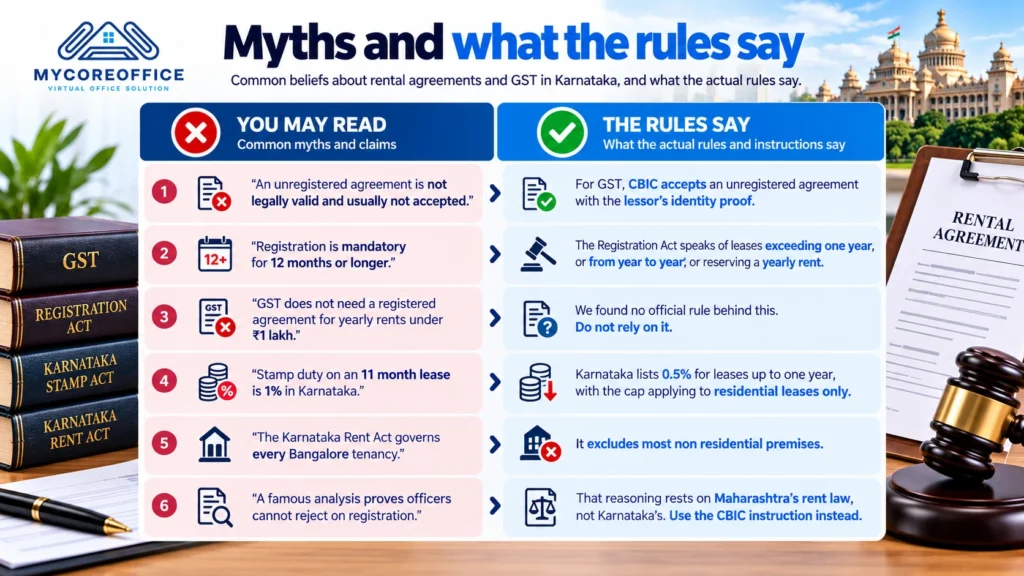
- You may read: “An unregistered agreement is not legally valid and usually not accepted.” The rules say: For GST, CBIC accepts it with the lessor ID.
- You may read: “Registration is mandatory for 12 months or longer.” The rules say: The Registration Act speaks of leases exceeding one year, or from year to year, or reserving a yearly rent.
- You may read: “GST does not need a registered agreement for yearly rents under ₹1 lakh.” The rules say: We found no official rule behind this. Do not rely on it.
- You may read: “Stamp duty on an 11 month lease is 1% in Karnataka.” The rules say: Karnataka lists 0.5% for leases up to one year, with the cap applying to residential leases only.
- You may read: “The Karnataka Rent Act governs every Bangalore tenancy.” The rules say: It excludes most non residential premises.
- You may read: “A famous analysis proves officers cannot reject on registration.” The rules say: That reasoning rests on Maharashtra’s rent law, not Karnataka’s. Use the CBIC instruction instead.
Should you register the lease anyway?
Sometimes yes. You gain stronger evidence if the landlord later disputes the rent or the term. It is compulsory when the lease goes beyond one year. It also gives both sides a public record, which can calm a nervous landlord.
The cost is stamp duty plus a registration fee, plus a visit to the Sub Registrar or an online booking through Kaveri. Fee rates change, so check the current rate before you budget.
Your pre filing checklist
- One ownership document of the lessor, in the owner’s name
- A copy of the lessor’s identity proof
- An e stamp certificate under the right article, with the UIN noted
- Monthly rent wording, and a term under one year
- The same name and address on every paper
- Signed copies with witnesses
- Scans within the file size limits
- A reminder to answer any REG-03 within 7 working days
FAQs
Is an unregistered rent agreement valid for GST registration in Karnataka?
Yes. CBIC accepts it with one ownership document of the lessor and a copy of the lessor’s identity proof.
Do I need to register an 11 month rent agreement in Karnataka?
Not under the Registration Act, as long as the term is under one year and the lease does not reserve a yearly rent. Ask your advocate to confirm your wording.
What extra document does an unregistered agreement need?
A copy of the lessor’s identity proof, along with one ownership document.
What stamp duty applies to a commercial rent agreement in Karnataka?
Karnataka lists 0.5% of average annual rent, advance, premium and fine for commercial leases up to one year. The ₹500 cap belongs to residential leases. Confirm the figure on Kaveri.
Is notarisation required for GST?
No. The CBIC instruction does not ask for a notarised rent agreement.
What if my landlord refuses to share an ID?
Explain that it only goes on the GST application. If he still refuses, a registered agreement removes the need for the lessor ID, though you will still need one ownership document.
Can I get GST without any rent agreement?
Yes. An affidavit, along with an ownership document of the lessor, is accepted where no agreement exists.
Will an officer reject my application because the agreement is unregistered?
Not for that reason alone. If a query arrives, reply in REG-04 and cite the instruction.
What if my lease is longer than one year and unregistered?
The law expects registration for such leases. Register it, or sign a fresh agreement that stays under one year.
Does a leave and licence agreement work for GST?
It often plays the same role as a rent agreement. Make sure it names the owner, premises and your business, and ask your drafter about the correct stamp article.
Is a coworking or virtual office agreement different?
It usually relies on a service agreement and a consent or NOC route. Officers focus on whether a real, staffed place exists.
Does the Karnataka Rent Act apply to my office?
It excludes most non residential premises, apart from small commercial spaces up to 14 square metres. Check with an advocate.
How long does GST approval take in Bangalore?
A low risk application can be approved in 3 working days under Rule 9A, other clean applications in about 7 working days, and flagged ones in up to 30 days.
What file size can I upload for the agreement?
The official GST checklist lists the rent or lease agreement at 1 MB, and ownership documents at 100 KB each. Check the portal for current limits.
Final thoughts
An unregistered rent agreement is not a flag, in Karnataka. It is a path that only requires one extra document and a bit of attention. Decide on your approach stamp the agreement correctly ensure rent payments are monthly collect the lessors packet and make sure every name matches. If an officer asks you to register the agreement respond calmly using REG-04. Refer to the official instruction.
If you want a second pair of eyes before you file, share your agreement and the lessor packet with the MyCoreOffice team, and we will go through them with you.
This guide shares general information and does not replace advice from an advocate or CA.
About the founder
Shivani, Founder of MyCoreOffice
Shivani built MyCoreOffice after more than a decade across coworking spaces, virtual offices, ecommerce and real estate. In that time she saw that GST problems rarely start with the law. They start with a paper that does not match, or a landlord who was never told what the officer needs.
Today MyCoreOffice supports founders in over 50 cities with GST registration, company registration, office space and coworking. Shivani believes a clear answer saves a founder weeks, which is why she backed a guide that explains the rules in plain words.
About the author
The MyCoreOffice Team
We work every day with GST registration, virtual office addresses and company registration. We follow CBIC Instruction No. 03/2025-GST and keep an eye on state level stamp and registration rules, so our guides stay close to what officers and landlords actually ask for.