

Table of Contents
Summary
Can a virtual office get GST registration in three working days? Sometimes. Three days is possible on two routes only. Rule 14A is the route you choose yourself, if your output tax on supplies to registered persons stays at or below ₹2.5 lakh a month and you complete Aadhaar authentication. Rule 9A is the route the GST portal chooses for you after it checks your application for risk. A virtual office address does not block either route, but nobody can promise you the fast lane.
If you miss it, the officer has seven working days when your Aadhaar authentication is done, and up to thirty days when a physical check or biometric visit applies. CBIC’s new Circular 257/03/2026 GST, issued on 26 October 2026, limits what officers can ask you. It also lists exactly when they can send a REG-03 notice. Meanwhile, a Delhi High Court order from 8 September 2026 on biometric checks is still unsettled, so keep your originals ready and your schedule flexible.
To protect your timeline make sure every name and address matches exactly use photos and scans check if your state requires electricity details ask your provider if your agreement mentions a specific suite or desk and check your portal every day. Plan, for seven days think of three as extra and remember thirty as your worst case.
Key takeaways
- Three working days applies only to Rule 14A and Rule 9A applications.
- You can opt into Rule 14A. You cannot opt into Rule 9A, because the portal selects you.
- Completing Aadhaar authentication moves you from the thirty day lane to the seven day lane.
- A 26 October 2026 circular now limits what officers can ask you, including questions about residential premises and utility bill amounts.
- A Delhi High Court order on biometric checks is still unsettled, so keep your schedule flexible.
Introduction
Your first client wants a GST invoice by Friday. One website says GST registration takes three days. Another says thirty. A third says “it depends” and stops there. You hold a virtual office agreement and one question. Which story is true for me?
This guide gives you the map. I, as your guide have read the rules, the newest CBIC circular and the latest court order so you do not have to. By the end you will know which lane your application will likely take, what you can control and what nobody can promise you.
The clear answer: Sometimes. Three working days is possible, but only on two routes. You choose one of them (Rule 14A). The GST portal chooses the other (Rule 9A). A virtual office address does not block either route, because the text of both rules says nothing about address type. Still, nobody can guarantee you the fast lane. If you miss it, the officer has seven working days when your Aadhaar authentication is complete, and thirty days when a physical check or biometric visit enters the picture. Plan for seven. Treat three as a bonus and thirty as your worst case.
What changed in the last few weeks
Three things happened, and most guides have not caught up.
On 8 September 2026, the Delhi High Court told authorities across India not to allow GST registration without biometric Aadhaar authentication, for the time being. We explain the details below.
On 8 October 2026, the GST Council met and recommended simpler registration, with clear document lists and drop down selections on the registration form. It also recommended a simpler route for small sellers on ecommerce platforms, called Rule 14B. These are recommendations, not rules you can use today.
On 26 October 2026, CBIC issued Circular 257/03/2026 GST. It speaks directly to applicants for the first time, and it settles several timeline arguments you will see online.
The three lanes: three days, seven days or thirty days
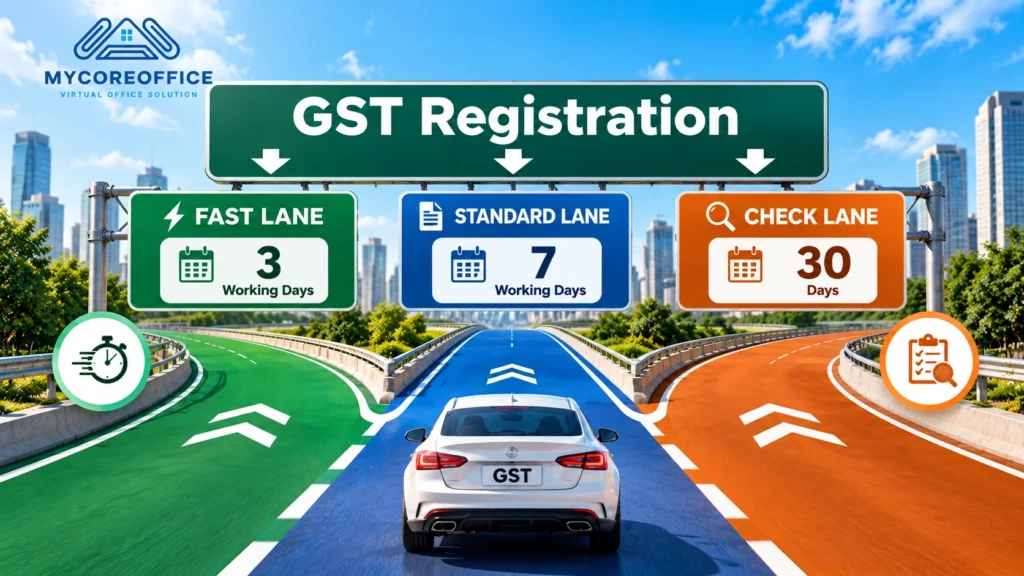
Think of GST registration as a road with three lanes. The lane you land in decides how long you wait.
The fast lane takes three working days. Two doors lead here. Rule 14A is the door you open yourself. Rule 9A is the door the portal opens for you when its checks find nothing worrying. We explain both below.
The standard lane takes seven working days. You land here when you complete Aadhaar authentication and the portal does not flag you. The officer must approve your application or send a query within that time. If the officer does nothing within the time limit, the circular says your registration counts as approved.
The check lane takes up to thirty days. You land here when you skip Aadhaar authentication, fail it, get flagged by the portal for a physical check, or when an officer orders one with senior approval. The officer must upload the visit report in FORM GST REG-30 at least five days before the thirty days end.
The circular gives applicants one clear piece of advice: opt for Aadhaar authentication, because it gets your application processed sooner. Take that advice.
Rule 9A and Rule 14A in plain words
People mix these two up constantly, so here is the simple difference.
Rule 9A is the portal’s decision. When your application reaches the common portal, its data analysis and risk parameters run in the background. If your application looks low risk, the portal grants registration electronically within three working days. You never see a checkbox for this. You simply find out when your GSTIN arrives.
Rule 14A is your decision. You tick “Yes” for Rule 14A in FORM GST REG-01 and declare that you will follow its conditions. In return, registration is granted electronically within three working days after successful Aadhaar authentication.
Here is the fine print on Rule 14A that catches people.
- Your output tax on supplies to registered persons must stay at or below ₹2.5 lakh a month. This cap counts only business to business supplies. The circular says small taxpayers who mainly supply to unregistered persons can use the scheme.
- You must opt for Aadhaar authentication. Without it, you do not qualify, unless you belong to a category the law exempts.
- You can hold one Rule 14A registration per State or Union Territory on the same PAN. Some online guides say one per PAN across all of India. The rule text says the limit applies inside the same State or UT, so read the rule yourself.
- Leaving the scheme means filing FORM GST REG-32. From 1 April 2026, you must first file returns for at least one tax period, plus every return that has fallen due.
- If you change details in your registration, you must amend them before you apply to leave.
Should you tick the box? Tick it if you run a small service business, consultancy or freelance practice and expect to stay under the cap. Skip it if you expect to cross ₹2.5 lakh of business to business output tax soon, because leaving later takes extra steps. Not sure? Ask your CA before you submit, since you make this choice on the form.
Three mistakes you will see in online guides
Mistake one: promising three days to everyone. The fast lane depends on Aadhaar authentication and on the portal’s risk checks. Nobody outside the system can promise it.
Mistake two: mixing up the two rules. Some articles treat Rule 9A as a physical verification rule. It is not. Rule 9A grants registration electronically. Physical checks sit under other rules.
Mistake three: copying old timelines. Older posts quote twenty one days for the physical check lane. The circular says thirty.
What you can and cannot control
You cannot see your risk score. The government has not published its risk parameters, so no provider can tell you exactly what the portal weighs. Tax professionals describe the usual signals as many registrations at one address, no filing history for the applicant, and details that do not match across records such as PAN and incorporation papers.
Here is the useful part. A virtual office address is not itself a trigger. The signals above come from patterns and mismatches, and you control the mismatches.
- Spell your legal name exactly as it appears on your PAN and your incorporation certificate.
- Copy your address from your agreement instead of retyping it.
- Use a mobile number linked to your Aadhaar and keep it near you for the OTP.
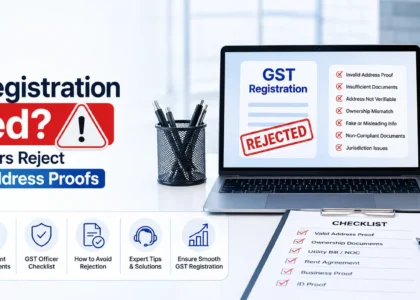
For a deeper look at what trips applications, read our guide on the seven reasons officers reject address proofs.
Biometric checks and the Delhi High Court order
This is the part that is still moving, so we will tell you exactly what we know.
On 8 September 2026, a Delhi High Court bench of Justice Anil Kshetarpal and Justice Shail Jain heard Neha v Union of India. The case involves stolen PAN and Aadhaar details used to create fake registrations. The bench directed authorities across the country not to allow any GST registration without biometric based Aadhaar authentication, for the time being. It also let authorities raise practical difficulties and listed the matter for 22 September. You can read the report from Juris Hour.
Before this order, biometric checks at a GST Suvidha Kendra applied mainly to applicants the portal selected on risk. As of 28 October 2026, we could not find a public report of what happened after the 22 September hearing. CBIC’s circular, issued six weeks later, still describes biometric checks as something the portal selects on risk.
So here is the honest position. If the order stands in full, a Facilitation Centre visit could become part of every new application, including Rule 14A ones. If it has been modified, the older risk based approach continues.
What should you do? Keep your original documents ready. Keep a few days of your schedule open for a centre visit. Ask your CA to confirm the current position on the day you apply. We will update this page as soon as the position becomes clear.
What the new circular means for your virtual office application
The circular reads like a rulebook for both sides of the table. These parts matter most to you.
Questions officers should no longer ask
The circular calls certain queries unwarranted. They include:
- Asking why your own residential address is not in the same city or state as the place where you seek registration.
- Asking for an Udyam certificate.
- Objecting that your kind of business cannot run from that premises.
- Judging whether an electricity connection is domestic or commercial, or reading meaning into the amount on a utility bill.
- Deciding that residential premises are unfit for business.
The first point helps founders who live in one state and register in another. If a query asks for any of these, you can reply politely and cite the circular. Officers may check a utility bill only for your name and address, and they may check a rent agreement only for validity, both parties’ names and the exact property address.
Only three reasons for a REG-03
An officer can issue FORM GST REG-03 in only three situations. A document is incomplete or hard to read. The address does not match the proof, or the proof does not look valid. Or the address is incomplete or vague.
The officer must issue the notice within seven working days of your submission. You then have seven working days to reply in FORM GST REG-04, and the officer has seven working days to decide. Add those up and the longest normal query path runs about twenty one working days. On the calendar, that lands close to the thirty days of a physical check, so a query costs you real time even though it is not a rejection. Check your portal and email daily while your application is open.
The coworking clause and your agreement
The circular spells out documents for owned, rented, consent based, coworking and SEZ premises. For coworking, it asks for a membership agreement that names the period and the specific suite, cabin or desk allotted to you. It also asks for a document in the provider’s name such as a property tax receipt, khata copy or utility bill, or, when the provider rents the premises, the registered lease between the provider and the owner.
The circular text we read does not use the words “virtual office,” and we did not see its annexures. So nobody can say for certain how an officer will classify a virtual office agreement. Still, you can protect yourself with two questions to your provider:
- Does my agreement name a specific suite, desk or unit?
- Can you share the registered lease between you and the owner?
Ask your CA to confirm which category fits your agreement. If you want to see how we handle documents and Bangalore specific steps, read our Bangalore walkthrough.
Your fast lane checklist for this week
These checks use the circular’s own guidance and sit on top of the document basics in our complete guide to virtual office GST registration.
- Pick the right possession type. If a family member or a partner owns the premises, the circular says you should not choose “own.” Choose consent, rented or shared as it fits.
- Use proper photographs. Upload a recent, clear photo of the person, not a group photo and not a crop of an ID card.
- Make the address specific. Include the building, floor and unit, the correct PIN, and place the map marker on the right spot. A vague address invites a REG-03.
- Check your state’s extra field. Maharashtra, Rajasthan, Odisha, Andhra Pradesh, Assam and Madhya Pradesh require electricity connection details for the premises.
- Keep scans clean. The circular says unreadable uploads cause queries and rejections.
- Decide on Rule 14A early. You make the choice on the form, so settle it before you submit.
- Watch your inbox. The portal sends every notice electronically, and your reply clock is seven working days.
Myths and facts

Myth: Rule 14A means a GSTIN in three days, guaranteed.
Fact: The rule promises grant within three working days after successful Aadhaar authentication. Working days exclude weekends and holidays, and later checks and cancellation rules still apply.
Myth: I can choose Rule 9A.
Fact: The portal selects applications for Rule 9A using its own data analysis.
Myth: A virtual office address means a physical check.
Fact: The circular lists the reasons for a physical check, and address type is not one of them. Portal flags, skipped Aadhaar authentication and officer decisions are.
Myth: A REG-03 means rejection.
Fact: It is a request for clarification. Rejection through FORM GST REG-05 comes after an unsatisfactory reply or no reply.
Myth: The rules are settled.
Fact: The Delhi High Court order and the Council’s recommendations mean parts of this process may change soon.
What we will not promise you
We will not promise a GSTIN in three days. No honest provider can, because the portal’s risk checks and Aadhaar authentication sit outside anyone’s control. What we can promise is plain talk. We will tell you which lane you are likely to land in, which documents help you, and what to do if a notice arrives.
If you want to talk it through, reach out through our GST registration page or contact us. Bring the two coworking questions above, and we will answer them straight.
Frequently asked questions
Can I choose Rule 9A for my application?
No. The common portal identifies applications for Rule 9A based on data analysis and risk parameters.
Does a virtual office address qualify for Rule 14A?
The text of Rule 14A sets conditions on tax liability, Aadhaar authentication and the number of registrations. It says nothing about address type. Your documents and risk checks still matter.
How long can a query add to my timeline?
The circular gives the officer seven working days to issue a REG-03, you seven working days to reply and the officer seven working days to decide. That adds up to about twenty one working days.
What happens if the officer does not act in time?
The circular says registration counts as approved when the officer takes no action within the time the rules allow.
Can I register at a virtual office in a state where I do not live?
The circular treats a query about your residence being in a different city or state as unwarranted. Still, keep your own address proof handy.
What if my agreement does not name a suite or desk?
Ask your provider to add it, and ask your CA how an officer may classify your arrangement.
Does Rule 14A let me skip a biometric visit?
The rule promises grant after successful Aadhaar authentication. The Delhi High Court order and the portal’s risk checks may still add a Facilitation Centre visit.
Conclusion
Three days is real. It is a lane, not a promise. I feel you can open the Rule 14A door by yourself and the portal may open the Rule 9A door for you. In every case plan, for seven working days and keep thirty in your back pocket.
Control what you can. Complete Aadhaar authentication, match every name and address letter for letter, ask the two coworking questions, and watch your portal daily. Then let the system do its work.
Last verified on 28 October 2026. This guide shares general information and is not legal advice. Confirm your case with a CA or GST practitioner.